
Unit conversion worksheets with answer keys
Six printable worksheets for the classroom, homework or tutoring. Each has a reference box, a worked example, 20 questions in graded parts, and an answer key with the working on page 2.
By Miguel Coelho · Edition 2.0 · 9 November 2026 · Free to print and share under CC BY 4.0
Choose a worksheet
| Worksheet | Typical level | Skills |
|---|---|---|
| Metric units | Ages 9–12 · Grades 4–7 · Years 5–8 | Moving the decimal point for powers of ten; Choosing multiply or divide from the size of the unit; Two-step conversions through the base unit |
| Imperial and metric | Ages 11–14 · Grades 6–9 · Years 7–10 | Using an exact conversion factor; Deciding whether to multiply or divide; Rounding to 2 decimal places at the end, not during the working |
| Temperature | Ages 11–14 · Grades 6–9 · Years 7–10 | Using a formula with an offset as well as a factor; Order of operations (brackets first); Negative temperatures |
| SI prefixes | Ages 14–18 · Grades 9–12 · Years 10–13 (physics, chemistry, electronics) | Reading SI prefixes as powers of ten; Converting between two prefixed units; Writing answers in scientific notation |
| Area and volume | Ages 11–15 · Grades 6–10 · Years 7–11 | Squaring the length factor for area; Cubing the length factor for volume; Linking volume to capacity (1 cm³ = 1 mL, 1 m³ = 1000 L) |
| Speed and rates | Ages 14–18 · Grades 9–12 · Years 10–13 (physics, chemistry, engineering) | Converting the top and bottom units of a rate; Writing conversion factors as fractions equal to 1; Cancelling units to check the working |
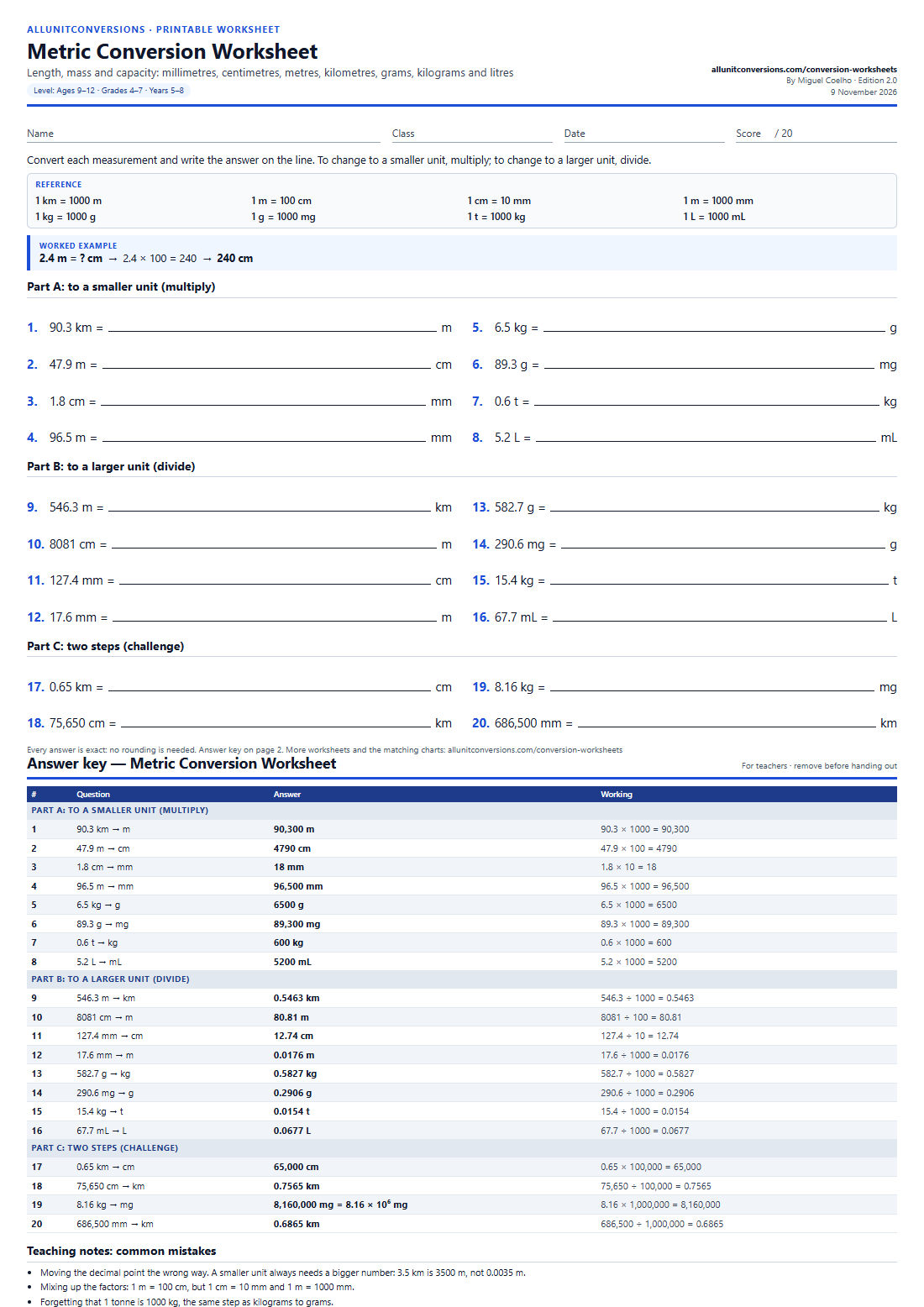
Metric Conversion Worksheet
Length, mass and capacity: millimetres, centimetres, metres, kilometres, grams, kilograms and litres.
Level: Ages 9–12 · Grades 4–7 · Years 5–8
- Moving the decimal point for powers of ten
- Choosing multiply or divide from the size of the unit
- Two-step conversions through the base unit
Convert each measurement and write the answer on the line. To change to a smaller unit, multiply; to change to a larger unit, divide.
Reference: 1 km = 1000 m · 1 m = 100 cm · 1 cm = 10 mm · 1 m = 1000 mm · 1 kg = 1000 g · 1 g = 1000 mg · 1 t = 1000 kg · 1 L = 1000 mL
Worked example: 2.4 m = ? cm → 2.4 × 100 = 240 → 240 cm
Part A: to a smaller unit (multiply)
- 1. 90.3 km = ____ m
- 2. 47.9 m = ____ cm
- 3. 1.8 cm = ____ mm
- 4. 96.5 m = ____ mm
- 5. 6.5 kg = ____ g
- 6. 89.3 g = ____ mg
- 7. 0.6 t = ____ kg
- 8. 5.2 L = ____ mL
Part B: to a larger unit (divide)
- 9. 546.3 m = ____ km
- 10. 8081 cm = ____ m
- 11. 127.4 mm = ____ cm
- 12. 17.6 mm = ____ m
- 13. 582.7 g = ____ kg
- 14. 290.6 mg = ____ g
- 15. 15.4 kg = ____ t
- 16. 67.7 mL = ____ L
Part C: two steps (challenge)
- 17. 0.65 km = ____ cm
- 18. 75,650 cm = ____ km
- 19. 8.16 kg = ____ mg
- 20. 686,500 mm = ____ km
Show the answer key and working
| # | Answer | Working |
|---|---|---|
| 1 | 90,300 m | 90.3 × 1000 = 90,300 |
| 2 | 4790 cm | 47.9 × 100 = 4790 |
| 3 | 18 mm | 1.8 × 10 = 18 |
| 4 | 96,500 mm | 96.5 × 1000 = 96,500 |
| 5 | 6500 g | 6.5 × 1000 = 6500 |
| 6 | 89,300 mg | 89.3 × 1000 = 89,300 |
| 7 | 600 kg | 0.6 × 1000 = 600 |
| 8 | 5200 mL | 5.2 × 1000 = 5200 |
| 9 | 0.5463 km | 546.3 ÷ 1000 = 0.5463 |
| 10 | 80.81 m | 8081 ÷ 100 = 80.81 |
| 11 | 12.74 cm | 127.4 ÷ 10 = 12.74 |
| 12 | 0.0176 m | 17.6 ÷ 1000 = 0.0176 |
| 13 | 0.5827 kg | 582.7 ÷ 1000 = 0.5827 |
| 14 | 0.2906 g | 290.6 ÷ 1000 = 0.2906 |
| 15 | 0.0154 t | 15.4 ÷ 1000 = 0.0154 |
| 16 | 0.0677 L | 67.7 ÷ 1000 = 0.0677 |
| 17 | 65,000 cm | 0.65 × 100,000 = 65,000 |
| 18 | 0.7565 km | 75,650 ÷ 100,000 = 0.7565 |
| 19 | 8,160,000 mg = 8.16 × 10⁶ mg | 8.16 × 1,000,000 = 8,160,000 |
| 20 | 0.6865 km | 686,500 ÷ 1,000,000 = 0.6865 |
Every answer is exact: no rounding is needed.
Common mistakes to watch for
- Moving the decimal point the wrong way. A smaller unit always needs a bigger number: 3.5 km is 3500 m, not 0.0035 m.
- Mixing up the factors: 1 m = 100 cm, but 1 cm = 10 mm and 1 m = 1000 mm.
- Forgetting that 1 tonne is 1000 kg, the same step as kilograms to grams.
Matching reference: metric conversion chart.
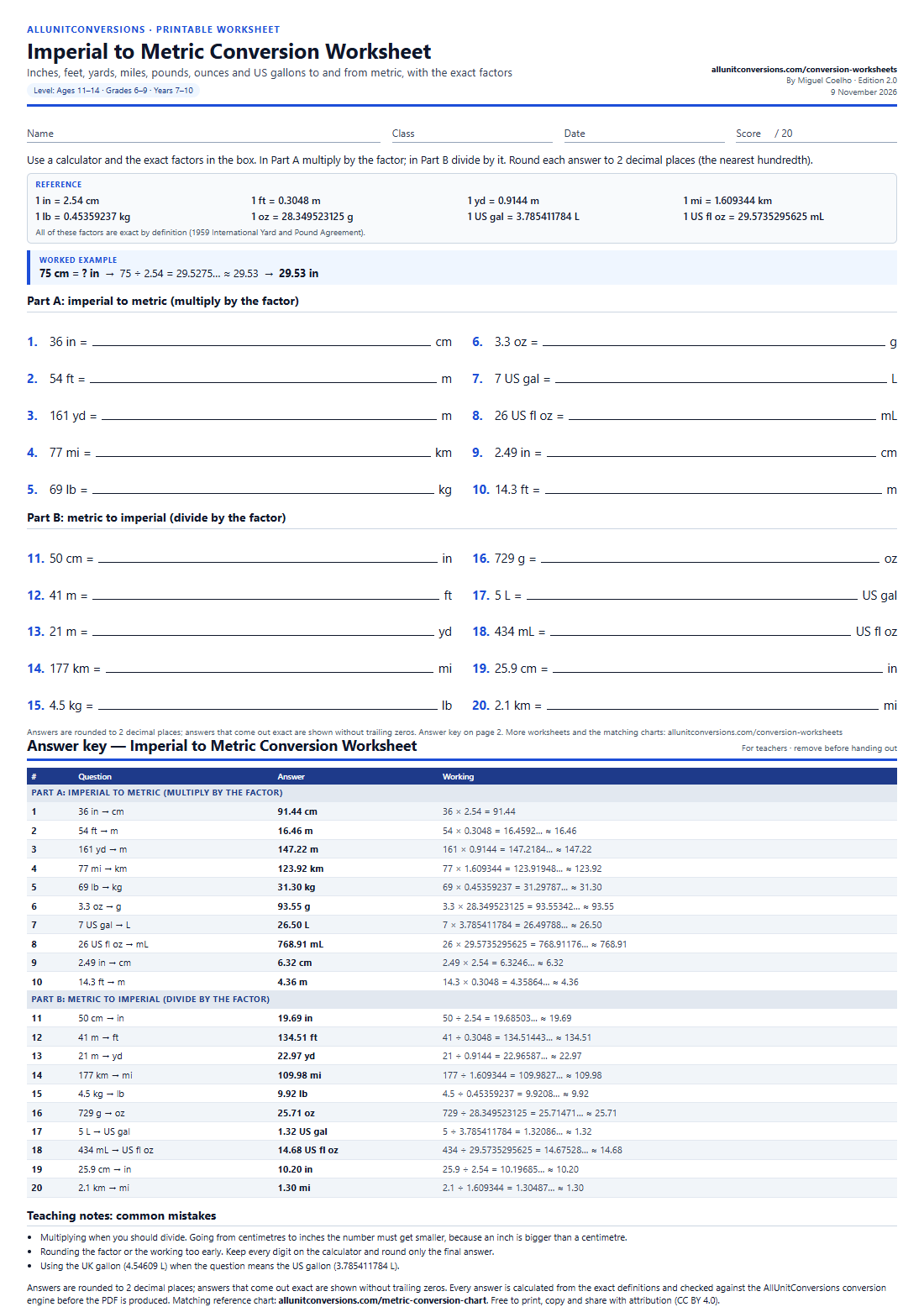
Imperial to Metric Conversion Worksheet
Inches, feet, yards, miles, pounds, ounces and US gallons to and from metric, with the exact factors.
Level: Ages 11–14 · Grades 6–9 · Years 7–10
- Using an exact conversion factor
- Deciding whether to multiply or divide
- Rounding to 2 decimal places at the end, not during the working
Use a calculator and the exact factors in the box. In Part A multiply by the factor; in Part B divide by it. Round each answer to 2 decimal places (the nearest hundredth).
Reference: 1 in = 2.54 cm · 1 ft = 0.3048 m · 1 yd = 0.9144 m · 1 mi = 1.609344 km · 1 lb = 0.45359237 kg · 1 oz = 28.349523125 g · 1 US gal = 3.785411784 L · 1 US fl oz = 29.5735295625 mL
Worked example: 75 cm = ? in → 75 ÷ 2.54 = 29.5275… ≈ 29.53 → 29.53 in
Part A: imperial to metric (multiply by the factor)
- 1. 36 in = ____ cm
- 2. 54 ft = ____ m
- 3. 161 yd = ____ m
- 4. 77 mi = ____ km
- 5. 69 lb = ____ kg
- 6. 3.3 oz = ____ g
- 7. 7 US gal = ____ L
- 8. 26 US fl oz = ____ mL
- 9. 2.49 in = ____ cm
- 10. 14.3 ft = ____ m
Part B: metric to imperial (divide by the factor)
- 11. 50 cm = ____ in
- 12. 41 m = ____ ft
- 13. 21 m = ____ yd
- 14. 177 km = ____ mi
- 15. 4.5 kg = ____ lb
- 16. 729 g = ____ oz
- 17. 5 L = ____ US gal
- 18. 434 mL = ____ US fl oz
- 19. 25.9 cm = ____ in
- 20. 2.1 km = ____ mi
Show the answer key and working
| # | Answer | Working |
|---|---|---|
| 1 | 91.44 cm | 36 × 2.54 = 91.44 |
| 2 | 16.46 m | 54 × 0.3048 = 16.4592… ≈ 16.46 |
| 3 | 147.22 m | 161 × 0.9144 = 147.2184… ≈ 147.22 |
| 4 | 123.92 km | 77 × 1.609344 = 123.91948… ≈ 123.92 |
| 5 | 31.30 kg | 69 × 0.45359237 = 31.29787… ≈ 31.30 |
| 6 | 93.55 g | 3.3 × 28.349523125 = 93.55342… ≈ 93.55 |
| 7 | 26.50 L | 7 × 3.785411784 = 26.49788… ≈ 26.50 |
| 8 | 768.91 mL | 26 × 29.5735295625 = 768.91176… ≈ 768.91 |
| 9 | 6.32 cm | 2.49 × 2.54 = 6.3246… ≈ 6.32 |
| 10 | 4.36 m | 14.3 × 0.3048 = 4.35864… ≈ 4.36 |
| 11 | 19.69 in | 50 ÷ 2.54 = 19.68503… ≈ 19.69 |
| 12 | 134.51 ft | 41 ÷ 0.3048 = 134.51443… ≈ 134.51 |
| 13 | 22.97 yd | 21 ÷ 0.9144 = 22.96587… ≈ 22.97 |
| 14 | 109.98 mi | 177 ÷ 1.609344 = 109.9827… ≈ 109.98 |
| 15 | 9.92 lb | 4.5 ÷ 0.45359237 = 9.9208… ≈ 9.92 |
| 16 | 25.71 oz | 729 ÷ 28.349523125 = 25.71471… ≈ 25.71 |
| 17 | 1.32 US gal | 5 ÷ 3.785411784 = 1.32086… ≈ 1.32 |
| 18 | 14.68 US fl oz | 434 ÷ 29.5735295625 = 14.67528… ≈ 14.68 |
| 19 | 10.20 in | 25.9 ÷ 2.54 = 10.19685… ≈ 10.20 |
| 20 | 1.30 mi | 2.1 ÷ 1.609344 = 1.30487… ≈ 1.30 |
Answers are rounded to 2 decimal places; answers that come out exact are shown without trailing zeros.
Common mistakes to watch for
- Multiplying when you should divide. Going from centimetres to inches the number must get smaller, because an inch is bigger than a centimetre.
- Rounding the factor or the working too early. Keep every digit on the calculator and round only the final answer.
- Using the UK gallon (4.54609 L) when the question means the US gallon (3.785411784 L).
Matching reference: metric conversion chart.
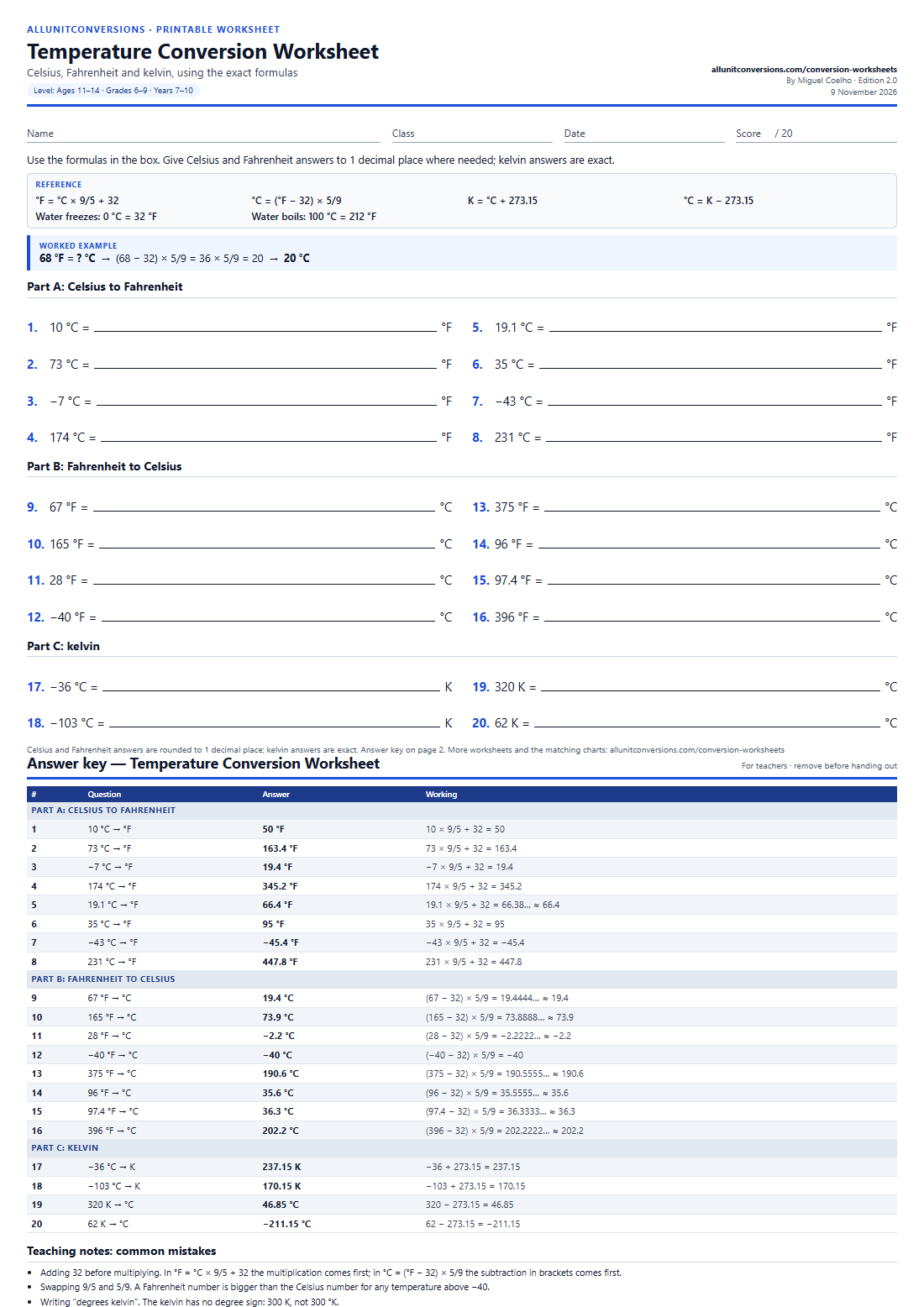
Temperature Conversion Worksheet
Celsius, Fahrenheit and kelvin, using the exact formulas.
Level: Ages 11–14 · Grades 6–9 · Years 7–10
- Using a formula with an offset as well as a factor
- Order of operations (brackets first)
- Negative temperatures
Use the formulas in the box. Give Celsius and Fahrenheit answers to 1 decimal place where needed; kelvin answers are exact.
Reference: °F = °C × 9/5 + 32 · °C = (°F − 32) × 5/9 · K = °C + 273.15 · °C = K − 273.15 · Water freezes: 0 °C = 32 °F · Water boils: 100 °C = 212 °F
Worked example: 68 °F = ? °C → (68 − 32) × 5/9 = 36 × 5/9 = 20 → 20 °C
Part A: Celsius to Fahrenheit
- 1. 10 °C = ____ °F
- 2. 73 °C = ____ °F
- 3. −7 °C = ____ °F
- 4. 174 °C = ____ °F
- 5. 19.1 °C = ____ °F
- 6. 35 °C = ____ °F
- 7. −43 °C = ____ °F
- 8. 231 °C = ____ °F
Part B: Fahrenheit to Celsius
- 9. 67 °F = ____ °C
- 10. 165 °F = ____ °C
- 11. 28 °F = ____ °C
- 12. −40 °F = ____ °C
- 13. 375 °F = ____ °C
- 14. 96 °F = ____ °C
- 15. 97.4 °F = ____ °C
- 16. 396 °F = ____ °C
Part C: kelvin
- 17. −36 °C = ____ K
- 18. −103 °C = ____ K
- 19. 320 K = ____ °C
- 20. 62 K = ____ °C
Show the answer key and working
| # | Answer | Working |
|---|---|---|
| 1 | 50 °F | 10 × 9/5 + 32 = 50 |
| 2 | 163.4 °F | 73 × 9/5 + 32 = 163.4 |
| 3 | 19.4 °F | −7 × 9/5 + 32 = 19.4 |
| 4 | 345.2 °F | 174 × 9/5 + 32 = 345.2 |
| 5 | 66.4 °F | 19.1 × 9/5 + 32 = 66.38… ≈ 66.4 |
| 6 | 95 °F | 35 × 9/5 + 32 = 95 |
| 7 | −45.4 °F | −43 × 9/5 + 32 = −45.4 |
| 8 | 447.8 °F | 231 × 9/5 + 32 = 447.8 |
| 9 | 19.4 °C | (67 − 32) × 5/9 = 19.4444… ≈ 19.4 |
| 10 | 73.9 °C | (165 − 32) × 5/9 = 73.8888… ≈ 73.9 |
| 11 | −2.2 °C | (28 − 32) × 5/9 = −2.2222… ≈ −2.2 |
| 12 | −40 °C | (−40 − 32) × 5/9 = −40 |
| 13 | 190.6 °C | (375 − 32) × 5/9 = 190.5555… ≈ 190.6 |
| 14 | 35.6 °C | (96 − 32) × 5/9 = 35.5555… ≈ 35.6 |
| 15 | 36.3 °C | (97.4 − 32) × 5/9 = 36.3333… ≈ 36.3 |
| 16 | 202.2 °C | (396 − 32) × 5/9 = 202.2222… ≈ 202.2 |
| 17 | 237.15 K | −36 + 273.15 = 237.15 |
| 18 | 170.15 K | −103 + 273.15 = 170.15 |
| 19 | 46.85 °C | 320 − 273.15 = 46.85 |
| 20 | −211.15 °C | 62 − 273.15 = −211.15 |
Celsius and Fahrenheit answers are rounded to 1 decimal place; kelvin answers are exact.
Common mistakes to watch for
- Adding 32 before multiplying. In °F = °C × 9/5 + 32 the multiplication comes first; in °C = (°F − 32) × 5/9 the subtraction in brackets comes first.
- Swapping 9/5 and 5/9. A Fahrenheit number is bigger than the Celsius number for any temperature above −40.
- Writing “degrees kelvin”. The kelvin has no degree sign: 300 K, not 300 °K.
Matching reference: temperature conversion chart.
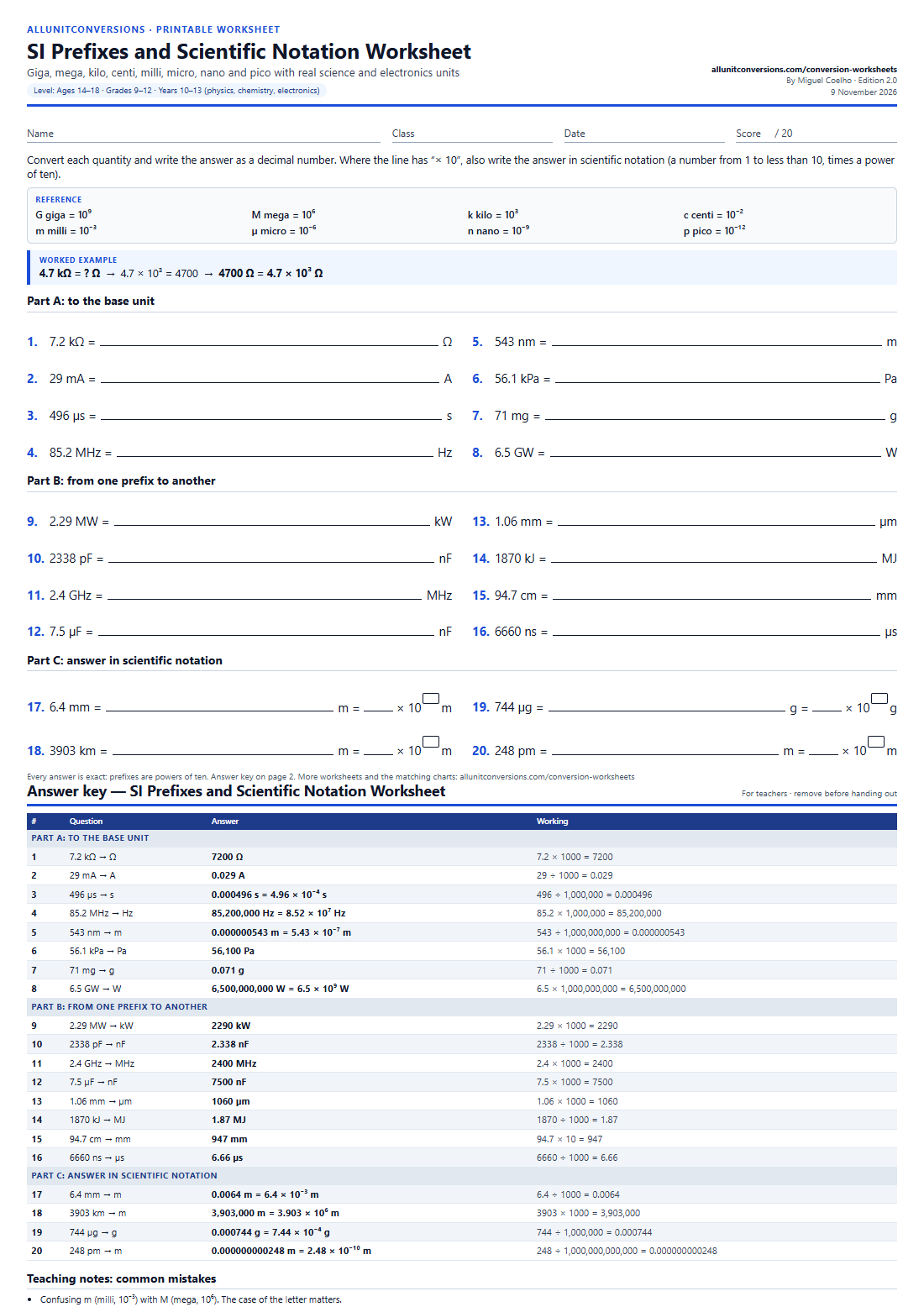
SI Prefixes and Scientific Notation Worksheet
Giga, mega, kilo, centi, milli, micro, nano and pico with real science and electronics units.
Level: Ages 14–18 · Grades 9–12 · Years 10–13 (physics, chemistry, electronics)
- Reading SI prefixes as powers of ten
- Converting between two prefixed units
- Writing answers in scientific notation
Convert each quantity and write the answer as a decimal number. Where the line has “× 10”, also write the answer in scientific notation (a number from 1 to less than 10, times a power of ten).
Reference: G giga = 10⁹ · M mega = 10⁶ · k kilo = 10³ · c centi = 10⁻² · m milli = 10⁻³ · µ micro = 10⁻⁶ · n nano = 10⁻⁹ · p pico = 10⁻¹²
Worked example: 4.7 kΩ = ? Ω → 4.7 × 10³ = 4700 → 4700 Ω = 4.7 × 10³ Ω
Part A: to the base unit
- 1. 7.2 kΩ = ____ Ω
- 2. 29 mA = ____ A
- 3. 496 µs = ____ s
- 4. 85.2 MHz = ____ Hz
- 5. 543 nm = ____ m
- 6. 56.1 kPa = ____ Pa
- 7. 71 mg = ____ g
- 8. 6.5 GW = ____ W
Part B: from one prefix to another
- 9. 2.29 MW = ____ kW
- 10. 2338 pF = ____ nF
- 11. 2.4 GHz = ____ MHz
- 12. 7.5 µF = ____ nF
- 13. 1.06 mm = ____ µm
- 14. 1870 kJ = ____ MJ
- 15. 94.7 cm = ____ mm
- 16. 6660 ns = ____ µs
Part C: answer in scientific notation
- 17. 6.4 mm = ____ m
- 18. 3903 km = ____ m
- 19. 744 µg = ____ g
- 20. 248 pm = ____ m
Show the answer key and working
| # | Answer | Working |
|---|---|---|
| 1 | 7200 Ω | 7.2 × 1000 = 7200 |
| 2 | 0.029 A | 29 ÷ 1000 = 0.029 |
| 3 | 0.000496 s = 4.96 × 10⁻⁴ s | 496 ÷ 1,000,000 = 0.000496 |
| 4 | 85,200,000 Hz = 8.52 × 10⁷ Hz | 85.2 × 1,000,000 = 85,200,000 |
| 5 | 0.000000543 m = 5.43 × 10⁻⁷ m | 543 ÷ 1,000,000,000 = 0.000000543 |
| 6 | 56,100 Pa | 56.1 × 1000 = 56,100 |
| 7 | 0.071 g | 71 ÷ 1000 = 0.071 |
| 8 | 6,500,000,000 W = 6.5 × 10⁹ W | 6.5 × 1,000,000,000 = 6,500,000,000 |
| 9 | 2290 kW | 2.29 × 1000 = 2290 |
| 10 | 2.338 nF | 2338 ÷ 1000 = 2.338 |
| 11 | 2400 MHz | 2.4 × 1000 = 2400 |
| 12 | 7500 nF | 7.5 × 1000 = 7500 |
| 13 | 1060 µm | 1.06 × 1000 = 1060 |
| 14 | 1.87 MJ | 1870 ÷ 1000 = 1.87 |
| 15 | 947 mm | 94.7 × 10 = 947 |
| 16 | 6.66 µs | 6660 ÷ 1000 = 6.66 |
| 17 | 0.0064 m = 6.4 × 10⁻³ m | 6.4 ÷ 1000 = 0.0064 |
| 18 | 3,903,000 m = 3.903 × 10⁶ m | 3903 × 1000 = 3,903,000 |
| 19 | 0.000744 g = 7.44 × 10⁻⁴ g | 744 ÷ 1,000,000 = 0.000744 |
| 20 | 0.000000000248 m = 2.48 × 10⁻¹⁰ m | 248 ÷ 1,000,000,000,000 = 0.000000000248 |
Every answer is exact: prefixes are powers of ten.
Common mistakes to watch for
- Confusing m (milli, 10⁻³) with M (mega, 10⁶). The case of the letter matters.
- Writing a capital K for kilo. The SI symbol is a lower-case k (km, kg, kΩ).
- Leaving the number in front of a power of ten outside 1 to 10 in scientific notation: write 4.7 × 10³, not 47 × 10².
Matching reference: engineering conversion chart with SI prefixes.
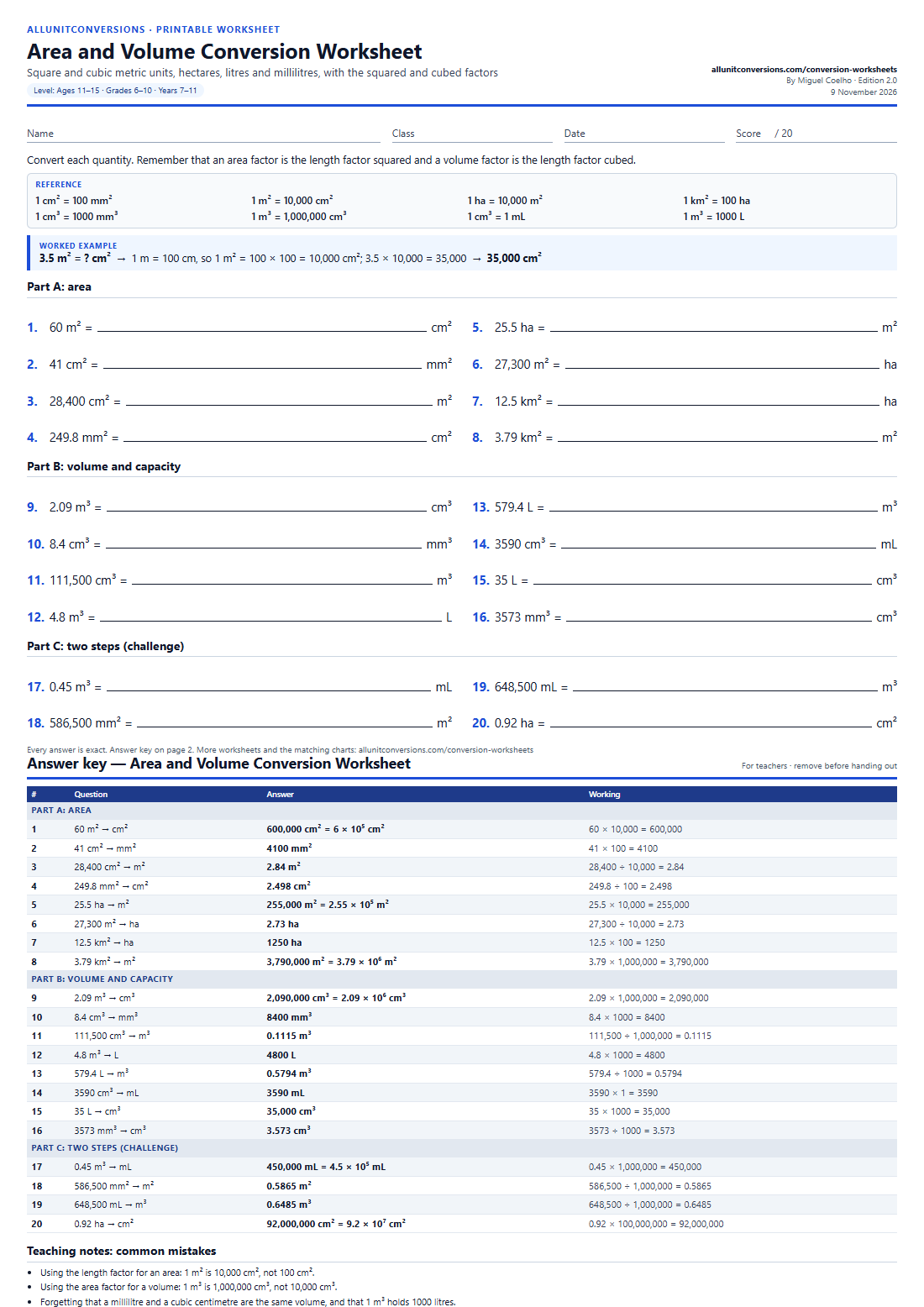
Area and Volume Conversion Worksheet
Square and cubic metric units, hectares, litres and millilitres, with the squared and cubed factors.
Level: Ages 11–15 · Grades 6–10 · Years 7–11
- Squaring the length factor for area
- Cubing the length factor for volume
- Linking volume to capacity (1 cm³ = 1 mL, 1 m³ = 1000 L)
Convert each quantity. Remember that an area factor is the length factor squared and a volume factor is the length factor cubed.
Reference: 1 cm² = 100 mm² · 1 m² = 10,000 cm² · 1 ha = 10,000 m² · 1 km² = 100 ha · 1 cm³ = 1000 mm³ · 1 m³ = 1,000,000 cm³ · 1 cm³ = 1 mL · 1 m³ = 1000 L
Worked example: 3.5 m² = ? cm² → 1 m = 100 cm, so 1 m² = 100 × 100 = 10,000 cm²; 3.5 × 10,000 = 35,000 → 35,000 cm²
Part A: area
- 1. 60 m² = ____ cm²
- 2. 41 cm² = ____ mm²
- 3. 28,400 cm² = ____ m²
- 4. 249.8 mm² = ____ cm²
- 5. 25.5 ha = ____ m²
- 6. 27,300 m² = ____ ha
- 7. 12.5 km² = ____ ha
- 8. 3.79 km² = ____ m²
Part B: volume and capacity
- 9. 2.09 m³ = ____ cm³
- 10. 8.4 cm³ = ____ mm³
- 11. 111,500 cm³ = ____ m³
- 12. 4.8 m³ = ____ L
- 13. 579.4 L = ____ m³
- 14. 3590 cm³ = ____ mL
- 15. 35 L = ____ cm³
- 16. 3573 mm³ = ____ cm³
Part C: two steps (challenge)
- 17. 0.45 m³ = ____ mL
- 18. 586,500 mm² = ____ m²
- 19. 648,500 mL = ____ m³
- 20. 0.92 ha = ____ cm²
Show the answer key and working
| # | Answer | Working |
|---|---|---|
| 1 | 600,000 cm² = 6 × 10⁵ cm² | 60 × 10,000 = 600,000 |
| 2 | 4100 mm² | 41 × 100 = 4100 |
| 3 | 2.84 m² | 28,400 ÷ 10,000 = 2.84 |
| 4 | 2.498 cm² | 249.8 ÷ 100 = 2.498 |
| 5 | 255,000 m² = 2.55 × 10⁵ m² | 25.5 × 10,000 = 255,000 |
| 6 | 2.73 ha | 27,300 ÷ 10,000 = 2.73 |
| 7 | 1250 ha | 12.5 × 100 = 1250 |
| 8 | 3,790,000 m² = 3.79 × 10⁶ m² | 3.79 × 1,000,000 = 3,790,000 |
| 9 | 2,090,000 cm³ = 2.09 × 10⁶ cm³ | 2.09 × 1,000,000 = 2,090,000 |
| 10 | 8400 mm³ | 8.4 × 1000 = 8400 |
| 11 | 0.1115 m³ | 111,500 ÷ 1,000,000 = 0.1115 |
| 12 | 4800 L | 4.8 × 1000 = 4800 |
| 13 | 0.5794 m³ | 579.4 ÷ 1000 = 0.5794 |
| 14 | 3590 mL | 3590 × 1 = 3590 |
| 15 | 35,000 cm³ | 35 × 1000 = 35,000 |
| 16 | 3.573 cm³ | 3573 ÷ 1000 = 3.573 |
| 17 | 450,000 mL = 4.5 × 10⁵ mL | 0.45 × 1,000,000 = 450,000 |
| 18 | 0.5865 m² | 586,500 ÷ 1,000,000 = 0.5865 |
| 19 | 0.6485 m³ | 648,500 ÷ 1,000,000 = 0.6485 |
| 20 | 92,000,000 cm² = 9.2 × 10⁷ cm² | 0.92 × 100,000,000 = 92,000,000 |
Every answer is exact.
Common mistakes to watch for
- Using the length factor for an area: 1 m² is 10,000 cm², not 100 cm².
- Using the area factor for a volume: 1 m³ is 1,000,000 cm³, not 10,000 cm³.
- Forgetting that a millilitre and a cubic centimetre are the same volume, and that 1 m³ holds 1000 litres.
Matching reference: metric conversion chart.
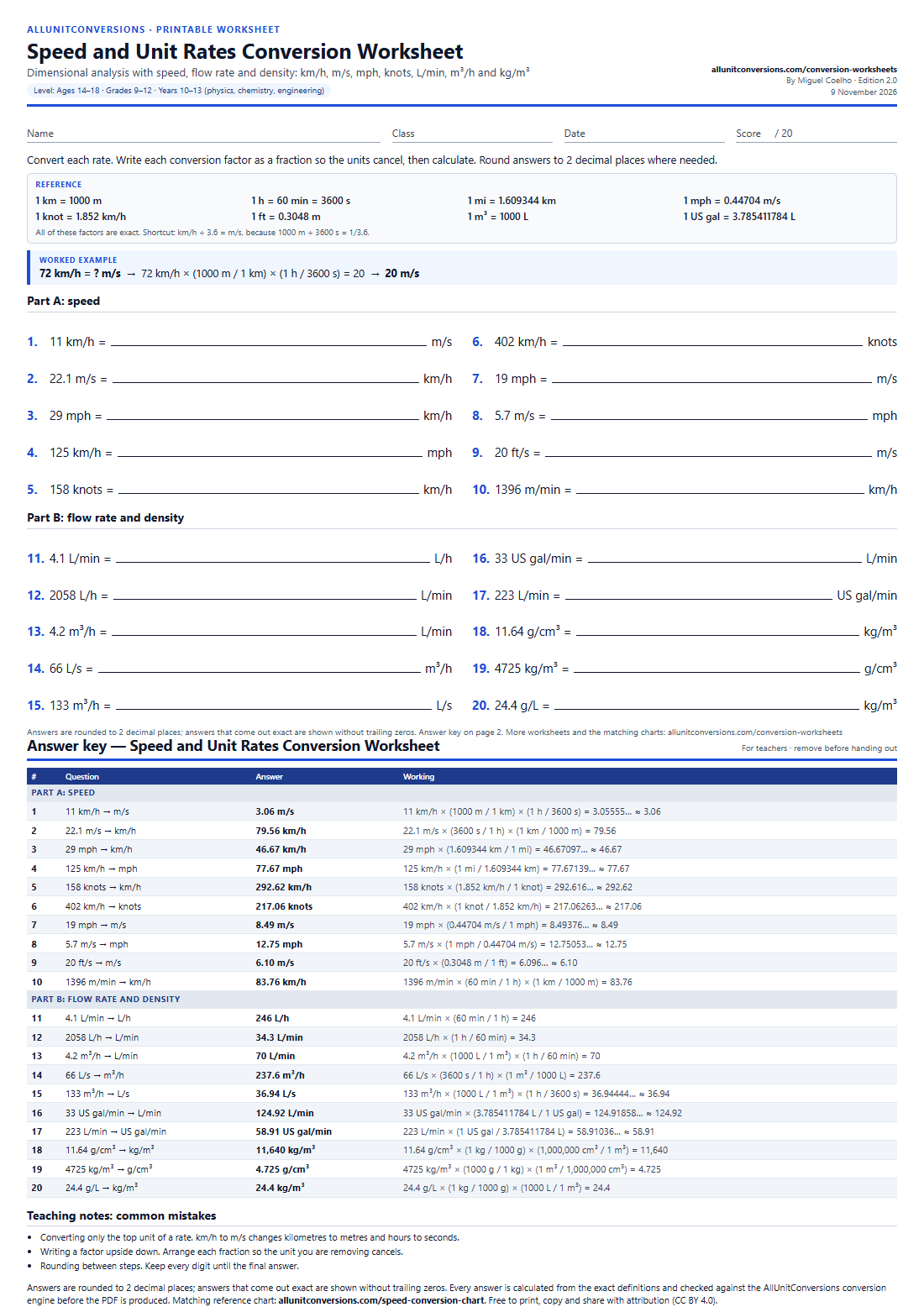
Speed and Unit Rates Conversion Worksheet
Dimensional analysis with speed, flow rate and density: km/h, m/s, mph, knots, L/min, m³/h and kg/m³.
Level: Ages 14–18 · Grades 9–12 · Years 10–13 (physics, chemistry, engineering)
- Converting the top and bottom units of a rate
- Writing conversion factors as fractions equal to 1
- Cancelling units to check the working
Convert each rate. Write each conversion factor as a fraction so the units cancel, then calculate. Round answers to 2 decimal places where needed.
Reference: 1 km = 1000 m · 1 h = 60 min = 3600 s · 1 mi = 1.609344 km · 1 mph = 0.44704 m/s · 1 knot = 1.852 km/h · 1 ft = 0.3048 m · 1 m³ = 1000 L · 1 US gal = 3.785411784 L
Worked example: 72 km/h = ? m/s → 72 km/h × (1000 m / 1 km) × (1 h / 3600 s) = 20 → 20 m/s
Part A: speed
- 1. 11 km/h = ____ m/s
- 2. 22.1 m/s = ____ km/h
- 3. 29 mph = ____ km/h
- 4. 125 km/h = ____ mph
- 5. 158 knots = ____ km/h
- 6. 402 km/h = ____ knots
- 7. 19 mph = ____ m/s
- 8. 5.7 m/s = ____ mph
- 9. 20 ft/s = ____ m/s
- 10. 1396 m/min = ____ km/h
Part B: flow rate and density
- 11. 4.1 L/min = ____ L/h
- 12. 2058 L/h = ____ L/min
- 13. 4.2 m³/h = ____ L/min
- 14. 66 L/s = ____ m³/h
- 15. 133 m³/h = ____ L/s
- 16. 33 US gal/min = ____ L/min
- 17. 223 L/min = ____ US gal/min
- 18. 11.64 g/cm³ = ____ kg/m³
- 19. 4725 kg/m³ = ____ g/cm³
- 20. 24.4 g/L = ____ kg/m³
Show the answer key and working
| # | Answer | Working |
|---|---|---|
| 1 | 3.06 m/s | 11 km/h × (1000 m / 1 km) × (1 h / 3600 s) = 3.05555… ≈ 3.06 |
| 2 | 79.56 km/h | 22.1 m/s × (3600 s / 1 h) × (1 km / 1000 m) = 79.56 |
| 3 | 46.67 km/h | 29 mph × (1.609344 km / 1 mi) = 46.67097… ≈ 46.67 |
| 4 | 77.67 mph | 125 km/h × (1 mi / 1.609344 km) = 77.67139… ≈ 77.67 |
| 5 | 292.62 km/h | 158 knots × (1.852 km/h / 1 knot) = 292.616… ≈ 292.62 |
| 6 | 217.06 knots | 402 km/h × (1 knot / 1.852 km/h) = 217.06263… ≈ 217.06 |
| 7 | 8.49 m/s | 19 mph × (0.44704 m/s / 1 mph) = 8.49376… ≈ 8.49 |
| 8 | 12.75 mph | 5.7 m/s × (1 mph / 0.44704 m/s) = 12.75053… ≈ 12.75 |
| 9 | 6.10 m/s | 20 ft/s × (0.3048 m / 1 ft) = 6.096… ≈ 6.10 |
| 10 | 83.76 km/h | 1396 m/min × (60 min / 1 h) × (1 km / 1000 m) = 83.76 |
| 11 | 246 L/h | 4.1 L/min × (60 min / 1 h) = 246 |
| 12 | 34.3 L/min | 2058 L/h × (1 h / 60 min) = 34.3 |
| 13 | 70 L/min | 4.2 m³/h × (1000 L / 1 m³) × (1 h / 60 min) = 70 |
| 14 | 237.6 m³/h | 66 L/s × (3600 s / 1 h) × (1 m³ / 1000 L) = 237.6 |
| 15 | 36.94 L/s | 133 m³/h × (1000 L / 1 m³) × (1 h / 3600 s) = 36.94444… ≈ 36.94 |
| 16 | 124.92 L/min | 33 US gal/min × (3.785411784 L / 1 US gal) = 124.91858… ≈ 124.92 |
| 17 | 58.91 US gal/min | 223 L/min × (1 US gal / 3.785411784 L) = 58.91036… ≈ 58.91 |
| 18 | 11,640 kg/m³ | 11.64 g/cm³ × (1 kg / 1000 g) × (1,000,000 cm³ / 1 m³) = 11,640 |
| 19 | 4.725 g/cm³ | 4725 kg/m³ × (1000 g / 1 kg) × (1 m³ / 1,000,000 cm³) = 4.725 |
| 20 | 24.4 kg/m³ | 24.4 g/L × (1 kg / 1000 g) × (1000 L / 1 m³) = 24.4 |
Answers are rounded to 2 decimal places; answers that come out exact are shown without trailing zeros.
Common mistakes to watch for
- Converting only the top unit of a rate. km/h to m/s changes kilometres to metres and hours to seconds.
- Writing a factor upside down. Arrange each fraction so the unit you are removing cancels.
- Rounding between steps. Keep every digit until the final answer.
Matching reference: speed conversion chart.
How to use the worksheets
- Graded parts. Part A practises the basic step, Part B the reverse, and Part C (where there is one) a two-step or challenge conversion, so a class can stop at the level that suits it.
- Calculators. The metric, SI prefix, and area and volume worksheets are designed to be done without a calculator. The imperial, temperature and rates worksheets expect one.
- Rounding. Answers that need rounding are rounded only at the end, from the exact value. Rounding the factor or the working early is the most common reason a student’s answer differs in the last decimal place.
- Wall charts. Print the classroom conversion pack or the metric conversion chart A3 poster to go with them.
Worksheet FAQs
Licence, answer keys, accuracy and year groups.
Are these worksheets free to use in class?
Yes. They are free to print, copy and share with students under CC BY 4.0, including on a school intranet or learning platform. Please keep the footer that credits All Unit Conversions.
Where is the answer key?
Page 2 of every PDF is the answer key, with the working for each question and short teaching notes on common mistakes. Print page 1 only for students. The answers are also shown on this page under each worksheet.
How are the answers checked?
Each answer is calculated from the exact definitions: powers of ten for metric prefixes, and the exact factors of the 1959 International Yard and Pound Agreement for inches, feet, pounds and gallons. The generator then checks every answer against the site’s conversion engine and refuses to produce the PDF if any answer disagrees.
Why do the questions never change?
Each worksheet is generated from a fixed seed, so the PDF you download today matches the answer key on this page and the copy a colleague printed last term. A new edition is published only when a worksheet is improved or corrected, and the edition number on the footer changes.
Which worksheet suits which year group?
Metric units suits ages 9–12 (grades 4–7). Imperial to metric, temperature, and area and volume suit ages 11–15. SI prefixes and the speed and rates worksheet suit ages 14–18, especially physics, chemistry and engineering courses. The level is printed at the top of each sheet.