
Electrical Units Conversion Chart
Quick-reference electrical units conversion chart. The tables below compare the most common units side by side. Download the free PDF for offline and printable use.
What is electrical energy, real power, and apparent power?
Kilowatt-hours (kWh) measure energy, kilowatts (kW) measure real power, and kilovolt-amperes (kVA) measure apparent power. These quantities are related but are not interchangeable.
FormulakVA = kWh ÷ (hours × power factor)
Key conversions
- Energy: kWh = kW × hours
- For a steady AC load: kVA = kW ÷ power factor
- A kWh-to-kVA calculation requires both operating time and power factor
Standards and method
Values are calculated from the shared conversion-factor library. Exact defined relationships are preserved; displayed results are rounded only for readability.
Maintained by Miguel Coelho. Updated . See our editorial policy.
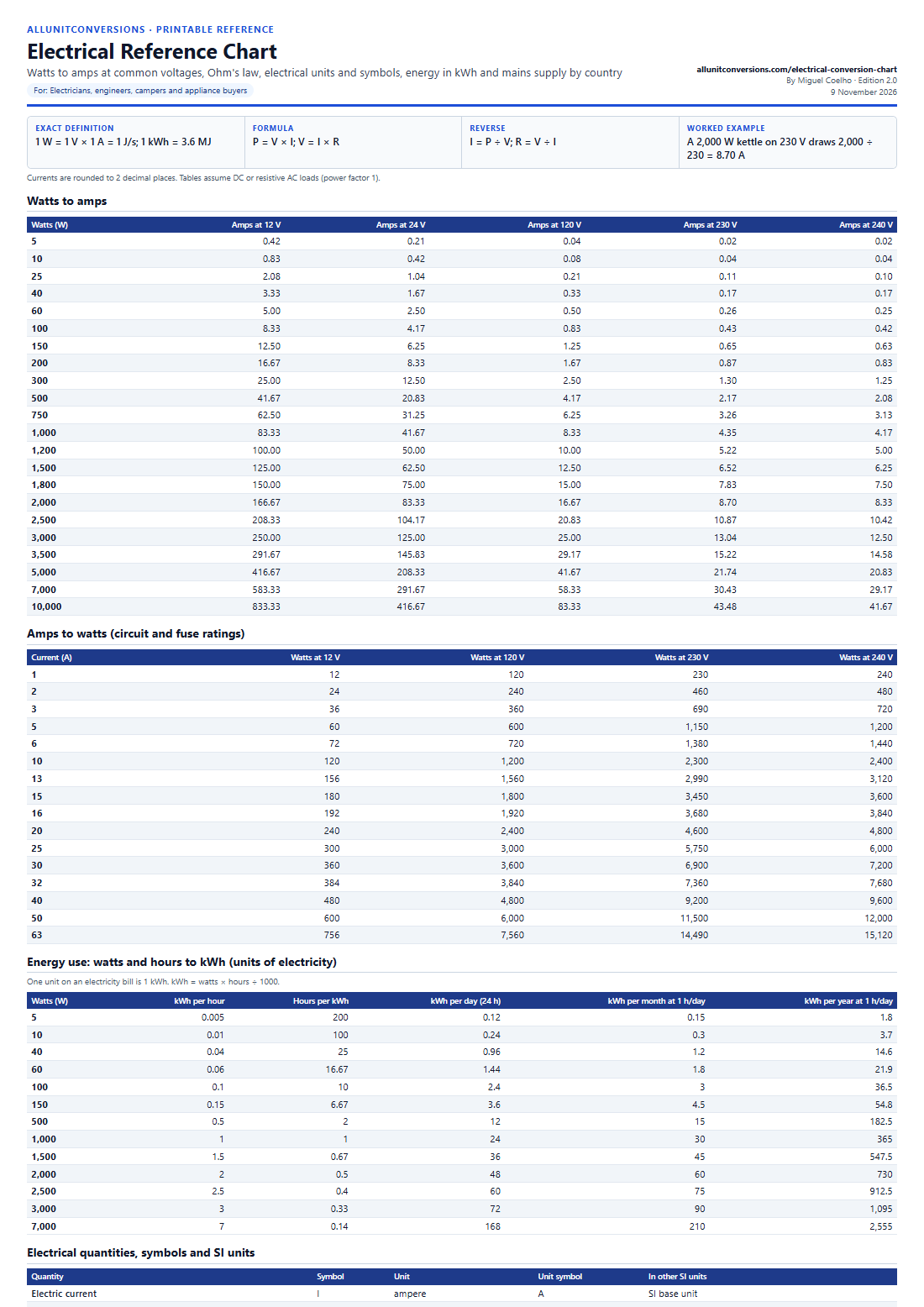
Printable electrical units conversion chart
Watts to amps at common voltages, Ohm's law, electrical units and symbols, energy in kWh and mains supply by country. Includes the exact definition, formulas, a worked example and sources. Conversion values are checked against the defining constants, and reference data is cited to its source, before the PDF is published.
Free to print, share and use in teaching materials with attribution (CC BY 4.0).
Also in the Electrician and Electronics Reference Pack, with related sheets in one PDF.
Electrical Units Conversion Table
Current
| Unit | per 1 A |
|---|---|
| Microampere (µA) | 1000000 µA |
| Milliampere (mA) | 1000 mA |
| Ampere (A) | 1 A |
| Kiloampere (kA) | 0.001 kA |
Voltage
| Unit | per 1 V |
|---|---|
| Microvolt (µV) | 1000000 µV |
| Millivolt (mV) | 1000 mV |
| Volt (V) | 1 V |
| Kilovolt (kV) | 0.001 kV |
| Megavolt (MV) | 1.0000e-6 MV |
Resistance
| Unit | per 1 Ω |
|---|---|
| Microohm (µΩ) | 1000000 µΩ |
| Milliohm (mΩ) | 1000 mΩ |
| Ohm (Ω) | 1 Ω |
| Kiloohm (kΩ) | 0.001 kΩ |
| Megaohm (MΩ) | 1.0000e-6 MΩ |
Capacitance
| Unit | per 1 F |
|---|---|
| Picofarad (pF) | 1.0000e+12 pF |
| Nanofarad (nF) | 1000000000 nF |
| Microfarad (µF) | 1000000 µF |
| Millifarad (mF) | 1000 mF |
| Farad (F) | 1 F |
Values are calculated from the shared conversion-factor library. Exact defined relationships are preserved; displayed results are rounded only for readability.
Full electrical units conversion chart
Watts to amps at common voltages, Ohm's law, electrical units and symbols, energy in kWh and mains supply by country. These are the same tables as the printable PDF. For: Electricians, engineers, campers and appliance buyers.
- Exact definition
- 1 W = 1 V × 1 A = 1 J/s; 1 kWh = 3.6 MJ
- Formula
- P = V × I; V = I × R
- Reverse
- I = P ÷ V; R = V ÷ I
- Worked example
- A 2,000 W kettle on 230 V draws 2,000 ÷ 230 = 8.70 A
- Rounding
- Currents are rounded to 2 decimal places. Tables assume DC or resistive AC loads (power factor 1).
Watts to amps
| Watts (W) | Amps at 12 V | Amps at 24 V | Amps at 120 V | Amps at 230 V | Amps at 240 V |
|---|---|---|---|---|---|
| 5 | 0.42 | 0.21 | 0.04 | 0.02 | 0.02 |
| 10 | 0.83 | 0.42 | 0.08 | 0.04 | 0.04 |
| 25 | 2.08 | 1.04 | 0.21 | 0.11 | 0.10 |
| 40 | 3.33 | 1.67 | 0.33 | 0.17 | 0.17 |
| 60 | 5.00 | 2.50 | 0.50 | 0.26 | 0.25 |
| 100 | 8.33 | 4.17 | 0.83 | 0.43 | 0.42 |
| 150 | 12.50 | 6.25 | 1.25 | 0.65 | 0.63 |
| 200 | 16.67 | 8.33 | 1.67 | 0.87 | 0.83 |
| 300 | 25.00 | 12.50 | 2.50 | 1.30 | 1.25 |
| 500 | 41.67 | 20.83 | 4.17 | 2.17 | 2.08 |
| 750 | 62.50 | 31.25 | 6.25 | 3.26 | 3.13 |
| 1,000 | 83.33 | 41.67 | 8.33 | 4.35 | 4.17 |
| 1,200 | 100.00 | 50.00 | 10.00 | 5.22 | 5.00 |
| 1,500 | 125.00 | 62.50 | 12.50 | 6.52 | 6.25 |
| 1,800 | 150.00 | 75.00 | 15.00 | 7.83 | 7.50 |
| 2,000 | 166.67 | 83.33 | 16.67 | 8.70 | 8.33 |
| 2,500 | 208.33 | 104.17 | 20.83 | 10.87 | 10.42 |
| 3,000 | 250.00 | 125.00 | 25.00 | 13.04 | 12.50 |
| 3,500 | 291.67 | 145.83 | 29.17 | 15.22 | 14.58 |
| 5,000 | 416.67 | 208.33 | 41.67 | 21.74 | 20.83 |
| 7,000 | 583.33 | 291.67 | 58.33 | 30.43 | 29.17 |
| 10,000 | 833.33 | 416.67 | 83.33 | 43.48 | 41.67 |
Amps to watts (circuit and fuse ratings)
| Current (A) | Watts at 12 V | Watts at 120 V | Watts at 230 V | Watts at 240 V |
|---|---|---|---|---|
| 1 | 12 | 120 | 230 | 240 |
| 2 | 24 | 240 | 460 | 480 |
| 3 | 36 | 360 | 690 | 720 |
| 5 | 60 | 600 | 1,150 | 1,200 |
| 6 | 72 | 720 | 1,380 | 1,440 |
| 10 | 120 | 1,200 | 2,300 | 2,400 |
| 13 | 156 | 1,560 | 2,990 | 3,120 |
| 15 | 180 | 1,800 | 3,450 | 3,600 |
| 16 | 192 | 1,920 | 3,680 | 3,840 |
| 20 | 240 | 2,400 | 4,600 | 4,800 |
| 25 | 300 | 3,000 | 5,750 | 6,000 |
| 30 | 360 | 3,600 | 6,900 | 7,200 |
| 32 | 384 | 3,840 | 7,360 | 7,680 |
| 40 | 480 | 4,800 | 9,200 | 9,600 |
| 50 | 600 | 6,000 | 11,500 | 12,000 |
| 63 | 756 | 7,560 | 14,490 | 15,120 |
Energy use: watts and hours to kWh (units of electricity)
One unit on an electricity bill is 1 kWh. kWh = watts × hours ÷ 1000.
| Watts (W) | kWh per hour | Hours per kWh | kWh per day (24 h) | kWh per month at 1 h/day | kWh per year at 1 h/day |
|---|---|---|---|---|---|
| 5 | 0.005 | 200 | 0.12 | 0.15 | 1.8 |
| 10 | 0.01 | 100 | 0.24 | 0.3 | 3.7 |
| 40 | 0.04 | 25 | 0.96 | 1.2 | 14.6 |
| 60 | 0.06 | 16.67 | 1.44 | 1.8 | 21.9 |
| 100 | 0.1 | 10 | 2.4 | 3 | 36.5 |
| 150 | 0.15 | 6.67 | 3.6 | 4.5 | 54.8 |
| 500 | 0.5 | 2 | 12 | 15 | 182.5 |
| 1,000 | 1 | 1 | 24 | 30 | 365 |
| 1,500 | 1.5 | 0.67 | 36 | 45 | 547.5 |
| 2,000 | 2 | 0.5 | 48 | 60 | 730 |
| 2,500 | 2.5 | 0.4 | 60 | 75 | 912.5 |
| 3,000 | 3 | 0.33 | 72 | 90 | 1,095 |
| 7,000 | 7 | 0.14 | 168 | 210 | 2,555 |
Electrical quantities, symbols and SI units
| Quantity | Symbol | Unit | Unit symbol | In other SI units |
|---|---|---|---|---|
| Electric current | I | ampere | A | SI base unit |
| Electric charge | Q | coulomb | C | A·s; 1 Ah = 3,600 C |
| Voltage (potential difference) | U or V | volt | V | W/A = J/C |
| Resistance | R | ohm | Ω | V/A |
| Conductance | G | siemens | S | A/V = 1/Ω |
| Resistivity | ρ | ohm metre | Ω·m | 1 Ω·mm²/m = 10⁻⁶ Ω·m |
| Capacitance | C | farad | F | C/V |
| Inductance | L | henry | H | Wb/A = V·s/A |
| Active power | P | watt | W | J/s = V·A at power factor 1 |
| Apparent power | S | volt-ampere | VA | V × A |
| Reactive power | Q | var | var | V × A × sin φ |
| Energy | E or W | joule | J | W·s; 1 kWh = 3.6 MJ |
| Frequency | f | hertz | Hz | 1/s |
| Magnetic flux | Φ | weber | Wb | V·s |
| Magnetic flux density | B | tesla | T | Wb/m² |
| Electric field strength | E | volt per metre | V/m | N/C |
Ohm's law and power formulas
| Find | From V and I / R | From P and I / V | From P and R |
|---|---|---|---|
| Voltage V (volts) | V = I × R | V = P ÷ I | V = √(P × R) |
| Current I (amps) | I = V ÷ R | I = P ÷ V | I = √(P ÷ R) |
| Resistance R (ohms) | R = V ÷ I | R = V² ÷ P | R = P ÷ I² |
| Power P (watts) | P = V × I | P = I² × R | P = V² ÷ R |
| Three-phase power | P = √3 × V(line) × I × PF | I = P ÷ (√3 × V × PF) | PF = power factor (0–1) |
Mains electricity by country (nominal)
| Country / region | Voltage | Frequency |
|---|---|---|
| United Kingdom, Ireland | 230 V | 50 Hz |
| European Union | 230 V | 50 Hz |
| United States, Canada | 120 V (240 V split-phase) | 60 Hz |
| Mexico | 127 V | 60 Hz |
| Brazil | 127 V or 220 V (varies by state) | 60 Hz |
| Japan | 100 V | 50 Hz east / 60 Hz west |
| China | 220 V | 50 Hz |
| India | 230 V | 50 Hz |
| Australia, New Zealand | 230 V | 50 Hz |
| South Africa | 230 V | 50 Hz |
Sources for this chart
Conversion values on this sheet are generated by the AllUnitConversions conversion library and automatically checked against the exact definitions above before the PDF is produced; reference tables are taken from the sources listed.
- BIPM SI Brochure, 9th edition — Definitions of the SI units, including the kelvin
- NIST Special Publication 811 — Guide for the Use of the International System of Units
- IEC 60038 — IEC standard voltages for electricity supply systems
Related Converters & Charts
Electrical Units Conversion Chart FAQs
Common questions about the electrical units conversion chart.
What does this electrical units conversion chart include?
It lists the most common electrical units units side by side with their conversion factors, plus a free printable PDF you can download for offline reference.
What exact definition is this electrical units chart based on?
1 W = 1 V × 1 A = 1 J/s; 1 kWh = 3.6 MJ. Formula: P = V × I; V = I × R. Currents are rounded to 2 decimal places. Tables assume DC or resistive AC loads (power factor 1).
Can I download this chart as a PDF, CSV, or JSON?
Yes. Use the Download A4 PDF or US Letter PDF buttons for a printable version, or download the same tables as CSV or JSON from the links on this page.