
Resistor Color Code Chart and Calculator
Pick the band colours to read a resistor, or look up any colour, multiplier, tolerance and temperature coefficient in the chart. The tables follow IEC 60062:2016, and the E-series values follow IEC 60063.
Resistor color code calculator
4.7 kΩ ±5%
Range 4.465 kΩ to 4.935 kΩ
Value to colour bands
4 bands: Yellow – Violet – Red – Gold (±5%)
5 bands: Yellow – Violet – Black – Brown – Brown (±1%)
Standards and method
Colour, tolerance and temperature-coefficient codes are transcribed from IEC 60062:2016 and cross-checked against a second published table; preferred values are from IEC 60063; every worked example and code table is calculated from those definitions.
Maintained by Miguel Coelho. Updated . See our editorial policy.
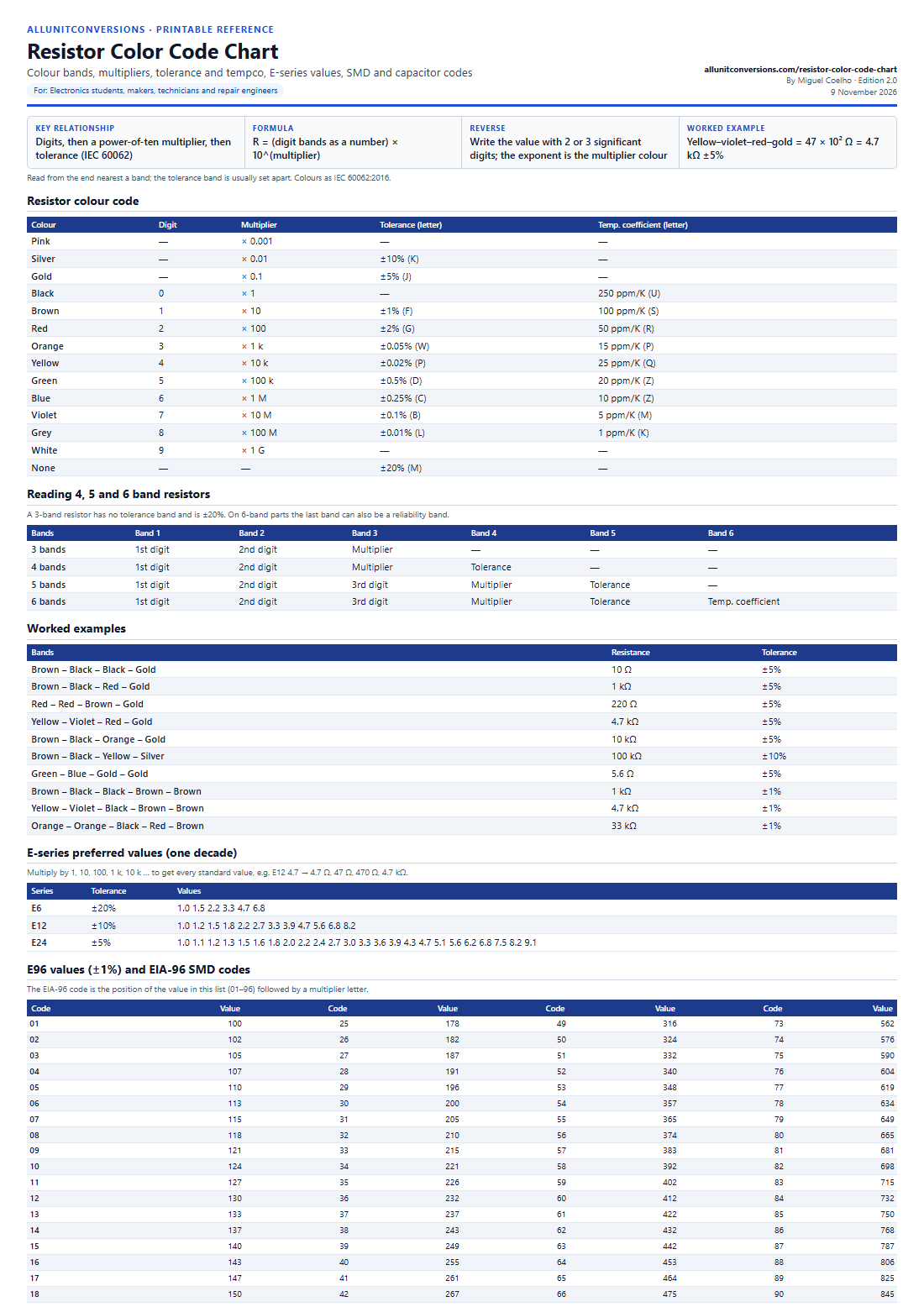
Printable resistor color code chart
Colour bands, multipliers, tolerance and tempco, E-series values, SMD and capacitor codes. Includes the exact definition, formulas, a worked example and sources. Conversion values are checked against the defining constants, and reference data is cited to its source, before the PDF is published.
Free to print, share and use in teaching materials with attribution (CC BY 4.0).
Also in the Electrician and Electronics Reference Pack, with related sheets in one PDF.
Full resistor color code chart
Colour bands, multipliers, tolerance and tempco, E-series values, SMD and capacitor codes. These are the same tables as the printable PDF. For: Electronics students, makers, technicians and repair engineers.
- Key relationship
- Digits, then a power-of-ten multiplier, then tolerance (IEC 60062)
- Formula
- R = (digit bands as a number) × 10^(multiplier)
- Reverse
- Write the value with 2 or 3 significant digits; the exponent is the multiplier colour
- Worked example
- Yellow–violet–red–gold = 47 × 10² Ω = 4.7 kΩ ±5%
- Rounding
- Read from the end nearest a band; the tolerance band is usually set apart. Colours as IEC 60062:2016.
Resistor colour code
| Colour | Digit | Multiplier | Tolerance (letter) | Temp. coefficient (letter) |
|---|---|---|---|---|
| Pink | — | × 0.001 | — | — |
| Silver | — | × 0.01 | ±10% (K) | — |
| Gold | — | × 0.1 | ±5% (J) | — |
| Black | 0 | × 1 | — | 250 ppm/K (U) |
| Brown | 1 | × 10 | ±1% (F) | 100 ppm/K (S) |
| Red | 2 | × 100 | ±2% (G) | 50 ppm/K (R) |
| Orange | 3 | × 1 k | ±0.05% (W) | 15 ppm/K (P) |
| Yellow | 4 | × 10 k | ±0.02% (P) | 25 ppm/K (Q) |
| Green | 5 | × 100 k | ±0.5% (D) | 20 ppm/K (Z) |
| Blue | 6 | × 1 M | ±0.25% (C) | 10 ppm/K (Z) |
| Violet | 7 | × 10 M | ±0.1% (B) | 5 ppm/K (M) |
| Grey | 8 | × 100 M | ±0.01% (L) | 1 ppm/K (K) |
| White | 9 | × 1 G | — | — |
| None | — | — | ±20% (M) | — |
Reading 4, 5 and 6 band resistors
A 3-band resistor has no tolerance band and is ±20%. On 6-band parts the last band can also be a reliability band.
| Bands | Band 1 | Band 2 | Band 3 | Band 4 | Band 5 | Band 6 |
|---|---|---|---|---|---|---|
| 3 bands | 1st digit | 2nd digit | Multiplier | — | — | — |
| 4 bands | 1st digit | 2nd digit | Multiplier | Tolerance | — | — |
| 5 bands | 1st digit | 2nd digit | 3rd digit | Multiplier | Tolerance | — |
| 6 bands | 1st digit | 2nd digit | 3rd digit | Multiplier | Tolerance | Temp. coefficient |
Worked examples
| Bands | Resistance | Tolerance |
|---|---|---|
| Brown – Black – Black – Gold | 10 Ω | ±5% |
| Brown – Black – Red – Gold | 1 kΩ | ±5% |
| Red – Red – Brown – Gold | 220 Ω | ±5% |
| Yellow – Violet – Red – Gold | 4.7 kΩ | ±5% |
| Brown – Black – Orange – Gold | 10 kΩ | ±5% |
| Brown – Black – Yellow – Silver | 100 kΩ | ±10% |
| Green – Blue – Gold – Gold | 5.6 Ω | ±5% |
| Brown – Black – Black – Brown – Brown | 1 kΩ | ±1% |
| Yellow – Violet – Black – Brown – Brown | 4.7 kΩ | ±1% |
| Orange – Orange – Black – Red – Brown | 33 kΩ | ±1% |
E-series preferred values (one decade)
Multiply by 1, 10, 100, 1 k, 10 k … to get every standard value, e.g. E12 4.7 → 4.7 Ω, 47 Ω, 470 Ω, 4.7 kΩ.
| Series | Tolerance | Values |
|---|---|---|
| E6 | ±20% | 1.0 1.5 2.2 3.3 4.7 6.8 |
| E12 | ±10% | 1.0 1.2 1.5 1.8 2.2 2.7 3.3 3.9 4.7 5.6 6.8 8.2 |
| E24 | ±5% | 1.0 1.1 1.2 1.3 1.5 1.6 1.8 2.0 2.2 2.4 2.7 3.0 3.3 3.6 3.9 4.3 4.7 5.1 5.6 6.2 6.8 7.5 8.2 9.1 |
E96 values (±1%) and EIA-96 SMD codes
The EIA-96 code is the position of the value in this list (01–96) followed by a multiplier letter.
| Code | Value | Code | Value | Code | Value | Code | Value |
|---|---|---|---|---|---|---|---|
| 01 | 100 | 25 | 178 | 49 | 316 | 73 | 562 |
| 02 | 102 | 26 | 182 | 50 | 324 | 74 | 576 |
| 03 | 105 | 27 | 187 | 51 | 332 | 75 | 590 |
| 04 | 107 | 28 | 191 | 52 | 340 | 76 | 604 |
| 05 | 110 | 29 | 196 | 53 | 348 | 77 | 619 |
| 06 | 113 | 30 | 200 | 54 | 357 | 78 | 634 |
| 07 | 115 | 31 | 205 | 55 | 365 | 79 | 649 |
| 08 | 118 | 32 | 210 | 56 | 374 | 80 | 665 |
| 09 | 121 | 33 | 215 | 57 | 383 | 81 | 681 |
| 10 | 124 | 34 | 221 | 58 | 392 | 82 | 698 |
| 11 | 127 | 35 | 226 | 59 | 402 | 83 | 715 |
| 12 | 130 | 36 | 232 | 60 | 412 | 84 | 732 |
| 13 | 133 | 37 | 237 | 61 | 422 | 85 | 750 |
| 14 | 137 | 38 | 243 | 62 | 432 | 86 | 768 |
| 15 | 140 | 39 | 249 | 63 | 442 | 87 | 787 |
| 16 | 143 | 40 | 255 | 64 | 453 | 88 | 806 |
| 17 | 147 | 41 | 261 | 65 | 464 | 89 | 825 |
| 18 | 150 | 42 | 267 | 66 | 475 | 90 | 845 |
| 19 | 154 | 43 | 274 | 67 | 487 | 91 | 866 |
| 20 | 158 | 44 | 280 | 68 | 499 | 92 | 887 |
| 21 | 162 | 45 | 287 | 69 | 511 | 93 | 909 |
| 22 | 165 | 46 | 294 | 70 | 523 | 94 | 931 |
| 23 | 169 | 47 | 301 | 71 | 536 | 95 | 953 |
| 24 | 174 | 48 | 309 | 72 | 549 | 96 | 976 |
EIA-96 multiplier letters
| Letter | Multiplier | Example | Resistance |
|---|---|---|---|
| Z | × 0.001 | 01Z | 100 mΩ |
| Y or R | × 0.01 | 68Y | 4.99 Ω |
| X or S | × 0.1 | 30X | 20 Ω |
| A | × 1 | 01A | 100 Ω |
| B or H | × 10 | 01B | 1 kΩ |
| C | × 100 | 01C | 10 kΩ |
| D | × 1,000 | 01D | 100 kΩ |
| E | × 10,000 | 01E | 1 MΩ |
| F | × 100,000 | 01F | 10 MΩ |
SMD resistor 3- and 4-digit codes
| Code | Rule | Resistance |
|---|---|---|
| 103 | 10 × 10³ | 10 kΩ |
| 472 | 47 × 10² | 4.7 kΩ |
| 100 | 10 × 10⁰ | 10 Ω |
| 4R7 | R marks the decimal point | 4.7 Ω |
| R47 | R marks the decimal point | 470 mΩ |
| 000 or 0 | Zero-ohm link (jumper) | 0 Ω |
| 1002 | 100 × 10² (1% parts) | 10 kΩ |
| 4701 | 470 × 10¹ | 4.7 kΩ |
| 2490 | 249 × 10⁰ | 249 Ω |
Capacitor codes (value in pF)
Two digits and a multiplier, in picofarads: 104 = 10 × 10⁴ pF = 100 nF. A third digit of 8 or 9 means × 0.01 or × 0.1.
| Code | Capacitance | Code | Capacitance |
|---|---|---|---|
| 101 | 100 pF | 471 | 470 pF |
| 102 | 1 nF | 222 | 2.2 nF |
| 103 | 10 nF | 472 | 4.7 nF |
| 104 | 100 nF | 224 | 220 nF |
| 105 | 1 µF | 474 | 470 nF |
| 106 | 10 µF | 109 | 1 pF |
Capacitor tolerance letters
| Letter | Tolerance | Typical use |
|---|---|---|
| B | ±0.1 pF | Small capacitors, below 10 pF |
| C | ±0.25 pF | Small capacitors, below 10 pF |
| D | ±0.5 pF (or ±0.5% above 10 pF) | Small capacitors and precision parts |
| F | ±1% | Precision film and C0G/NP0 ceramic |
| G | ±2% | Precision film and C0G/NP0 ceramic |
| J | ±5% | Film, C0G/NP0 ceramic |
| K | ±10% | Film, X7R ceramic |
| M | ±20% | Electrolytic, X7R and Y5V ceramic |
| Z | +80% / −20% | Y5V and Z5U ceramic (decoupling) |
Sources for this chart
Colour, tolerance and temperature-coefficient codes are transcribed from IEC 60062:2016 and cross-checked against a second published table; preferred values are from IEC 60063; every worked example and code table is calculated from those definitions.
- IEC 60062:2016 — Marking codes for resistors and capacitors (colour code, letter and digit codes)
- IEC 60063:2015 — Preferred number series for resistors and capacitors (E series)
- EIA-96 marking code — Three-character code for 1% surface-mount resistors (E96 index + multiplier letter)
Related Converters & Charts
Resistor Color Code Chart and Calculator FAQs
Common questions about the resistor color code chart.
How do you read a 4 band resistor?
Read from the end away from the gold or silver band. Bands 1 and 2 are digits, band 3 is the power-of-ten multiplier and band 4 is the tolerance. Yellow, violet, red, gold is 47 × 100 = 4.7 kΩ ±5%.
What is the difference between a 4 band and a 5 band resistor?
A 5 band resistor has three digit bands instead of two, so it can show values from the E96 series used for 1% and tighter parts. The fourth band is the multiplier and the fifth is the tolerance; a sixth band, if present, is the temperature coefficient.
What does the code 103 mean on an SMD resistor or capacitor?
The first two digits are the value and the third is the number of zeros: 103 is 10 × 10³, so 10 kΩ on a resistor or 10,000 pF (10 nF) on a capacitor.
Can I download this chart as a PDF, CSV, or JSON?
Yes. Use the Download A4 PDF or US Letter PDF buttons for a printable version, or download the same tables as CSV or JSON from the links on this page.