
Radiography Formulas and Dose Limits Chart
Quick-reference radiography formulas conversion chart. The tables below compare the most common units side by side. Download the free PDF for offline and printable use.
Standards and method
Inverse-square and half-value-layer factors are calculated exactly; formulas and grid factors are standard radiographic relationships; dose limits are quoted from the documents listed.
Maintained by Miguel Coelho. Updated . See our editorial policy.
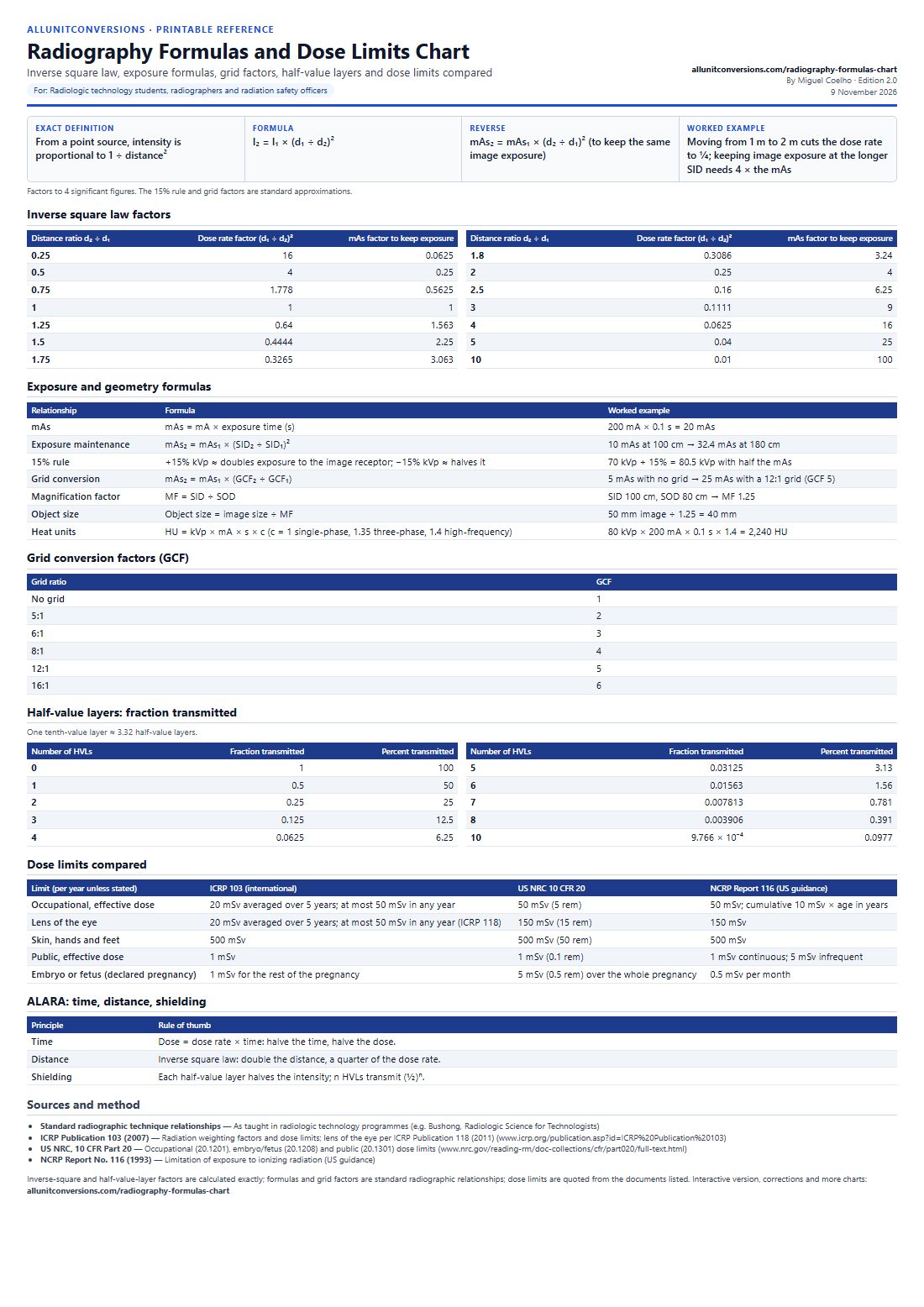
Printable radiography formulas chart
Inverse square law, exposure formulas, grid factors, half-value layers and dose limits compared. Includes the exact definition, formulas, a worked example and sources. Conversion values are checked against the defining constants, and reference data is cited to its source, before the PDF is published.
Free to print, share and use in teaching materials with attribution (CC BY 4.0).
Also in the Radiation Safety and Radiologic Technology Pack, with related sheets in one PDF.
Full radiography formulas chart
Inverse square law, exposure formulas, grid factors, half-value layers and dose limits compared. These are the same tables as the printable PDF. For: Radiologic technology students, radiographers and radiation safety officers.
- Exact definition
- From a point source, intensity is proportional to 1 ÷ distance²
- Formula
- I₂ = I₁ × (d₁ ÷ d₂)²
- Reverse
- mAs₂ = mAs₁ × (d₂ ÷ d₁)² (to keep the same image exposure)
- Worked example
- Moving from 1 m to 2 m cuts the dose rate to ¼; keeping image exposure at the longer SID needs 4 × the mAs
- Rounding
- Factors to 4 significant figures. The 15% rule and grid factors are standard approximations.
Inverse square law factors
| Distance ratio d₂ ÷ d₁ | Dose rate factor (d₁ ÷ d₂)² | mAs factor to keep exposure |
|---|---|---|
| 0.25 | 16 | 0.0625 |
| 0.5 | 4 | 0.25 |
| 0.75 | 1.778 | 0.5625 |
| 1 | 1 | 1 |
| 1.25 | 0.64 | 1.563 |
| 1.5 | 0.4444 | 2.25 |
| 1.75 | 0.3265 | 3.063 |
| Distance ratio d₂ ÷ d₁ | Dose rate factor (d₁ ÷ d₂)² | mAs factor to keep exposure |
|---|---|---|
| 1.8 | 0.3086 | 3.24 |
| 2 | 0.25 | 4 |
| 2.5 | 0.16 | 6.25 |
| 3 | 0.1111 | 9 |
| 4 | 0.0625 | 16 |
| 5 | 0.04 | 25 |
| 10 | 0.01 | 100 |
Exposure and geometry formulas
| Relationship | Formula | Worked example |
|---|---|---|
| mAs | mAs = mA × exposure time (s) | 200 mA × 0.1 s = 20 mAs |
| Exposure maintenance | mAs₂ = mAs₁ × (SID₂ ÷ SID₁)² | 10 mAs at 100 cm → 32.4 mAs at 180 cm |
| 15% rule | +15% kVp ≈ doubles exposure to the image receptor; −15% kVp ≈ halves it | 70 kVp + 15% = 80.5 kVp with half the mAs |
| Grid conversion | mAs₂ = mAs₁ × (GCF₂ ÷ GCF₁) | 5 mAs with no grid → 25 mAs with a 12:1 grid (GCF 5) |
| Magnification factor | MF = SID ÷ SOD | SID 100 cm, SOD 80 cm → MF 1.25 |
| Object size | Object size = image size ÷ MF | 50 mm image ÷ 1.25 = 40 mm |
| Heat units | HU = kVp × mA × s × c (c = 1 single-phase, 1.35 three-phase, 1.4 high-frequency) | 80 kVp × 200 mA × 0.1 s × 1.4 = 2,240 HU |
Grid conversion factors (GCF)
| Grid ratio | GCF |
|---|---|
| No grid | 1 |
| 5:1 | 2 |
| 6:1 | 3 |
| 8:1 | 4 |
| 12:1 | 5 |
| 16:1 | 6 |
Half-value layers: fraction transmitted
One tenth-value layer ≈ 3.32 half-value layers.
| Number of HVLs | Fraction transmitted | Percent transmitted |
|---|---|---|
| 0 | 1 | 100 |
| 1 | 0.5 | 50 |
| 2 | 0.25 | 25 |
| 3 | 0.125 | 12.5 |
| 4 | 0.0625 | 6.25 |
| Number of HVLs | Fraction transmitted | Percent transmitted |
|---|---|---|
| 5 | 0.03125 | 3.13 |
| 6 | 0.01563 | 1.56 |
| 7 | 0.007813 | 0.781 |
| 8 | 0.003906 | 0.391 |
| 10 | 9.766 × 10⁻⁴ | 0.0977 |
Dose limits compared
| Limit (per year unless stated) | ICRP 103 (international) | US NRC 10 CFR 20 | NCRP Report 116 (US guidance) |
|---|---|---|---|
| Occupational, effective dose | 20 mSv averaged over 5 years; at most 50 mSv in any year | 50 mSv (5 rem) | 50 mSv; cumulative 10 mSv × age in years |
| Lens of the eye | 20 mSv averaged over 5 years; at most 50 mSv in any year (ICRP 118) | 150 mSv (15 rem) | 150 mSv |
| Skin, hands and feet | 500 mSv | 500 mSv (50 rem) | 500 mSv |
| Public, effective dose | 1 mSv | 1 mSv (0.1 rem) | 1 mSv continuous; 5 mSv infrequent |
| Embryo or fetus (declared pregnancy) | 1 mSv for the rest of the pregnancy | 5 mSv (0.5 rem) over the whole pregnancy | 0.5 mSv per month |
ALARA: time, distance, shielding
| Principle | Rule of thumb |
|---|---|
| Time | Dose = dose rate × time: halve the time, halve the dose. |
| Distance | Inverse square law: double the distance, a quarter of the dose rate. |
| Shielding | Each half-value layer halves the intensity; n HVLs transmit (½)ⁿ. |
Sources for this chart
Inverse-square and half-value-layer factors are calculated exactly; formulas and grid factors are standard radiographic relationships; dose limits are quoted from the documents listed.
- Standard radiographic technique relationships — As taught in radiologic technology programmes (e.g. Bushong, Radiologic Science for Technologists)
- ICRP Publication 103 (2007) — Radiation weighting factors and dose limits; lens of the eye per ICRP Publication 118 (2011)
- US NRC, 10 CFR Part 20 — Occupational (20.1201), embryo/fetus (20.1208) and public (20.1301) dose limits
- NCRP Report No. 116 (1993) — Limitation of exposure to ionizing radiation (US guidance)
Related Converters & Charts
Radiography Formulas and Dose Limits Chart FAQs
Common questions about the radiography formulas chart.
What does this radiography formulas conversion chart include?
It lists the most common radiography formulas units side by side with their conversion factors, plus a free printable PDF you can download for offline reference.
What exact definition is this radiography formulas chart based on?
From a point source, intensity is proportional to 1 ÷ distance². Formula: I₂ = I₁ × (d₁ ÷ d₂)². Factors to 4 significant figures. The 15% rule and grid factors are standard approximations.
Can I download this chart as a PDF, CSV, or JSON?
Yes. Use the Download A4 PDF or US Letter PDF buttons for a printable version, or download the same tables as CSV or JSON from the links on this page.