
mAh to Wh Battery Chart and Airline Limits
Airline rules use watt-hours, but power banks are labelled in milliamp-hours. Multiply mAh by the cell voltage and divide by 1000 to get Wh; the tables below do it for common sizes, and the calculator handles any battery.
mAh to Wh calculator
74 Wh
Up to 100 Wh: carry-on without airline approval (at most two power banks per person).
Wh = mAh × V ÷ 1000. Rules as of the ICAO addendum of 27 March 2026; airlines can be stricter.
Standards and method
Watt-hours are calculated from Wh = mAh × V ÷ 1000; airline rules are summarised from the ICAO addendum and IATA guidance listed, current at the edition date.
Maintained by Miguel Coelho. Updated . See our editorial policy.
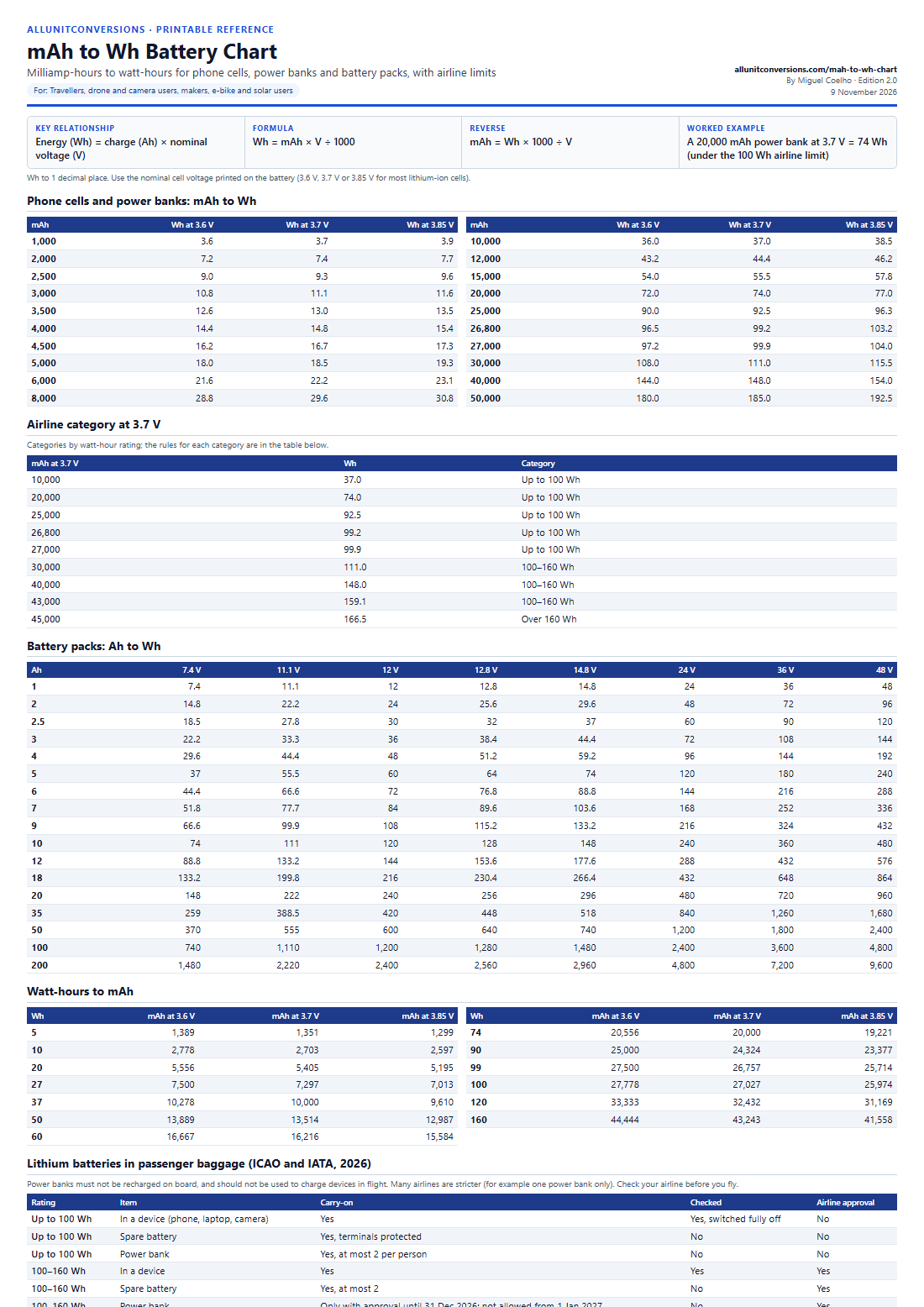
Printable mAh to Wh chart
Milliamp-hours to watt-hours for phone cells, power banks and battery packs, with airline limits. Includes the exact definition, formulas, a worked example and sources. Conversion values are checked against the defining constants, and reference data is cited to its source, before the PDF is published.
Free to print, share and use in teaching materials with attribution (CC BY 4.0).
Also in the Electrician and Electronics Reference Pack, with related sheets in one PDF.
Full mAh to Wh chart
Milliamp-hours to watt-hours for phone cells, power banks and battery packs, with airline limits. These are the same tables as the printable PDF. For: Travellers, drone and camera users, makers, e-bike and solar users.
- Key relationship
- Energy (Wh) = charge (Ah) × nominal voltage (V)
- Formula
- Wh = mAh × V ÷ 1000
- Reverse
- mAh = Wh × 1000 ÷ V
- Worked example
- A 20,000 mAh power bank at 3.7 V = 74 Wh (under the 100 Wh airline limit)
- Rounding
- Wh to 1 decimal place. Use the nominal cell voltage printed on the battery (3.6 V, 3.7 V or 3.85 V for most lithium-ion cells).
Phone cells and power banks: mAh to Wh
| mAh | Wh at 3.6 V | Wh at 3.7 V | Wh at 3.85 V |
|---|---|---|---|
| 1,000 | 3.6 | 3.7 | 3.9 |
| 2,000 | 7.2 | 7.4 | 7.7 |
| 2,500 | 9.0 | 9.3 | 9.6 |
| 3,000 | 10.8 | 11.1 | 11.6 |
| 3,500 | 12.6 | 13.0 | 13.5 |
| 4,000 | 14.4 | 14.8 | 15.4 |
| 4,500 | 16.2 | 16.7 | 17.3 |
| 5,000 | 18.0 | 18.5 | 19.3 |
| 6,000 | 21.6 | 22.2 | 23.1 |
| 8,000 | 28.8 | 29.6 | 30.8 |
| mAh | Wh at 3.6 V | Wh at 3.7 V | Wh at 3.85 V |
|---|---|---|---|
| 10,000 | 36.0 | 37.0 | 38.5 |
| 12,000 | 43.2 | 44.4 | 46.2 |
| 15,000 | 54.0 | 55.5 | 57.8 |
| 20,000 | 72.0 | 74.0 | 77.0 |
| 25,000 | 90.0 | 92.5 | 96.3 |
| 26,800 | 96.5 | 99.2 | 103.2 |
| 27,000 | 97.2 | 99.9 | 104.0 |
| 30,000 | 108.0 | 111.0 | 115.5 |
| 40,000 | 144.0 | 148.0 | 154.0 |
| 50,000 | 180.0 | 185.0 | 192.5 |
Airline category at 3.7 V
Categories by watt-hour rating; the rules for each category are in the table below.
| mAh at 3.7 V | Wh | Category |
|---|---|---|
| 10,000 | 37.0 | Up to 100 Wh |
| 20,000 | 74.0 | Up to 100 Wh |
| 25,000 | 92.5 | Up to 100 Wh |
| 26,800 | 99.2 | Up to 100 Wh |
| 27,000 | 99.9 | Up to 100 Wh |
| 30,000 | 111.0 | 100–160 Wh |
| 40,000 | 148.0 | 100–160 Wh |
| 43,000 | 159.1 | 100–160 Wh |
| 45,000 | 166.5 | Over 160 Wh |
Battery packs: Ah to Wh
| Ah | 7.4 V | 11.1 V | 12 V | 12.8 V | 14.8 V | 24 V | 36 V | 48 V |
|---|---|---|---|---|---|---|---|---|
| 1 | 7.4 | 11.1 | 12 | 12.8 | 14.8 | 24 | 36 | 48 |
| 2 | 14.8 | 22.2 | 24 | 25.6 | 29.6 | 48 | 72 | 96 |
| 2.5 | 18.5 | 27.8 | 30 | 32 | 37 | 60 | 90 | 120 |
| 3 | 22.2 | 33.3 | 36 | 38.4 | 44.4 | 72 | 108 | 144 |
| 4 | 29.6 | 44.4 | 48 | 51.2 | 59.2 | 96 | 144 | 192 |
| 5 | 37 | 55.5 | 60 | 64 | 74 | 120 | 180 | 240 |
| 6 | 44.4 | 66.6 | 72 | 76.8 | 88.8 | 144 | 216 | 288 |
| 7 | 51.8 | 77.7 | 84 | 89.6 | 103.6 | 168 | 252 | 336 |
| 9 | 66.6 | 99.9 | 108 | 115.2 | 133.2 | 216 | 324 | 432 |
| 10 | 74 | 111 | 120 | 128 | 148 | 240 | 360 | 480 |
| 12 | 88.8 | 133.2 | 144 | 153.6 | 177.6 | 288 | 432 | 576 |
| 18 | 133.2 | 199.8 | 216 | 230.4 | 266.4 | 432 | 648 | 864 |
| 20 | 148 | 222 | 240 | 256 | 296 | 480 | 720 | 960 |
| 35 | 259 | 388.5 | 420 | 448 | 518 | 840 | 1,260 | 1,680 |
| 50 | 370 | 555 | 600 | 640 | 740 | 1,200 | 1,800 | 2,400 |
| 100 | 740 | 1,110 | 1,200 | 1,280 | 1,480 | 2,400 | 3,600 | 4,800 |
| 200 | 1,480 | 2,220 | 2,400 | 2,560 | 2,960 | 4,800 | 7,200 | 9,600 |
Watt-hours to mAh
| Wh | mAh at 3.6 V | mAh at 3.7 V | mAh at 3.85 V |
|---|---|---|---|
| 5 | 1,389 | 1,351 | 1,299 |
| 10 | 2,778 | 2,703 | 2,597 |
| 20 | 5,556 | 5,405 | 5,195 |
| 27 | 7,500 | 7,297 | 7,013 |
| 37 | 10,278 | 10,000 | 9,610 |
| 50 | 13,889 | 13,514 | 12,987 |
| 60 | 16,667 | 16,216 | 15,584 |
| Wh | mAh at 3.6 V | mAh at 3.7 V | mAh at 3.85 V |
|---|---|---|---|
| 74 | 20,556 | 20,000 | 19,221 |
| 90 | 25,000 | 24,324 | 23,377 |
| 99 | 27,500 | 26,757 | 25,714 |
| 100 | 27,778 | 27,027 | 25,974 |
| 120 | 33,333 | 32,432 | 31,169 |
| 160 | 44,444 | 43,243 | 41,558 |
Lithium batteries in passenger baggage (ICAO and IATA, 2026)
Power banks must not be recharged on board, and should not be used to charge devices in flight. Many airlines are stricter (for example one power bank only). Check your airline before you fly.
| Rating | Item | Carry-on | Checked | Airline approval |
|---|---|---|---|---|
| Up to 100 Wh | In a device (phone, laptop, camera) | Yes | Yes, switched fully off | No |
| Up to 100 Wh | Spare battery | Yes, terminals protected | No | No |
| Up to 100 Wh | Power bank | Yes, at most 2 per person | No | No |
| 100–160 Wh | In a device | Yes | Yes | Yes |
| 100–160 Wh | Spare battery | Yes, at most 2 | No | Yes |
| 100–160 Wh | Power bank | Only with approval until 31 Dec 2026; not allowed from 1 Jan 2027 | No | Yes |
| Over 160 Wh | Any | No: cargo only, under the Dangerous Goods Regulations | No | — |
Useful battery formulas
| To find | Formula | Example |
|---|---|---|
| Watt-hours | Wh = mAh × V ÷ 1000 | 5,000 mAh × 3.85 V ÷ 1000 = 19.25 Wh |
| Milliamp-hours | mAh = Wh × 1000 ÷ V | 99 Wh × 1000 ÷ 3.7 V = 26,757 mAh |
| Runtime | hours ≈ Wh × efficiency ÷ load (W) | 100 Wh × 0.85 ÷ 20 W = 4.25 h |
| Power-bank output at 5 V | mAh(5 V) ≈ mAh × 3.7 ÷ 5 × efficiency | 20,000 mAh × 3.7 ÷ 5 × 0.85 = 12,580 mAh |
| Charge time | hours ≈ Ah ÷ charge current (A) × 1.2 | 5 Ah ÷ 2 A × 1.2 = 3 h |
Sources for this chart
Watt-hours are calculated from Wh = mAh × V ÷ 1000; airline rules are summarised from the ICAO addendum and IATA guidance listed, current at the edition date.
- ICAO Doc 9284 Technical Instructions 2025–2026, Addendum No. 1 (27 March 2026) — Power banks: carry-on only, at most two per person, not recharged on board
- IATA, Changes Regarding Power Banks: guidance for operators (31 March 2026) — Passenger table for lithium batteries; 100–160 Wh power-bank approval not carried into the 68th edition DGR (1 January 2027)
Related Converters & Charts
mAh to Wh Battery Chart and Airline Limits FAQs
Common questions about the mAh to Wh chart.
How many Wh is a 20,000 mAh power bank?
At the usual 3.7 V cell voltage, 20,000 × 3.7 ÷ 1000 = 74 Wh, under the 100 Wh limit for carry-on power banks without airline approval.
What is the largest power bank I can take on a plane?
Up to 100 Wh (about 27,000 mAh at 3.7 V) needs no approval. Under the ICAO addendum of 27 March 2026, each passenger may carry at most two power banks, in carry-on baggage only, and must not recharge them on board. Power banks over 100 Wh need airline approval until 31 December 2026 and are not allowed from 1 January 2027. Airlines can be stricter.
How do you convert Wh to mAh?
mAh = Wh × 1000 ÷ V. A 99 Wh battery at 3.7 V is 99,000 ÷ 3.7 = 26,757 mAh.
Can I download this chart as a PDF, CSV, or JSON?
Yes. Use the Download A4 PDF or US Letter PDF buttons for a printable version, or download the same tables as CSV or JSON from the links on this page.