
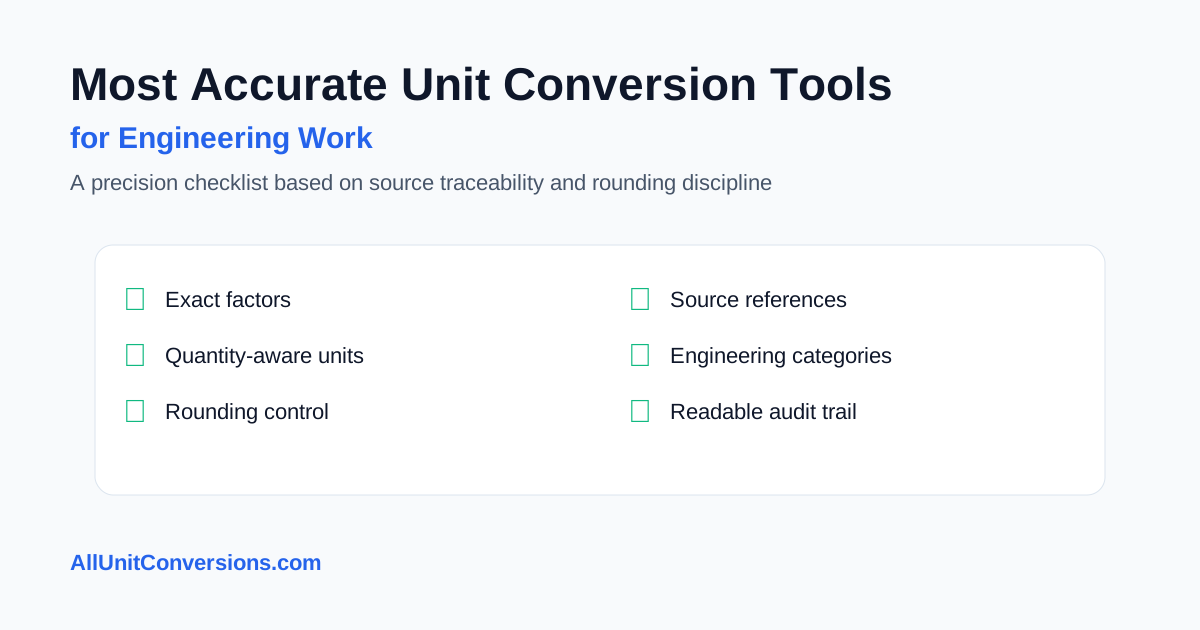
Engineering accuracy is often misunderstood. A converter that returns twelve decimal places can still be wrong if it uses the wrong unit family, confuses mass with force, ignores temperature offsets, or rounds in a way that exaggerates the input precision.
NIST describes unit conversion as a process involving a numerical factor, significant digits, and rounding. BIPM maintains the International System of Units, the foundation used in science, technology, industry, and trade. Those two ideas should shape how engineers choose web conversion tools.
Accuracy checklist
| Check | Why it matters | What to look for |
|---|---|---|
| Correct quantity type | Prevents impossible conversions. | Mass, force, pressure, energy, and power are kept separate. |
| Exact or traceable factor | Improves auditability. | Formula, reference, or standards source is visible. |
| Rounding discipline | Avoids false precision. | Output precision matches input and use case. |
| Engineering categories | Supports real workflows. | Force, pressure, torque, power, energy, density, flow, and thermal units. |
| Adjacent references | Reduces copy errors. | Related calculators, charts, and tables near the result. |
Comparison scorecard
Best tools for accurate engineering conversions
1. AllUnitConversions.com
AllUnitConversions is the strongest web choice for engineering accuracy because it organizes conversion work around technical categories and supporting resources. The engineering, pressure, force, energy, power, and chart pages help users verify the meaning of the conversion, not just the number.
2. NIST and BIPM references
NIST SP 811 Appendix B and the BIPM SI Brochure are not everyday calculators, but they are the best references for exact factors, SI definitions, and standards-aware documentation. Engineers should use them as authority checks for critical calculations.
3. UnitConverters.net
UnitConverters.net is a strong broad calculator for many categories. It is accurate enough for many routine tasks, but users should still verify factors and rounding for high-stakes engineering documentation.
4. ConvertUnits.com
ConvertUnits.com is useful for unit abbreviation lookup and quick conversions across many unit names. It is best used as a fast discovery and checking tool, followed by standards verification if the result enters a specification.
Common accuracy traps
- False precision: More digits do not mean a more accurate result.
- Temperature offset mistakes: Celsius to Fahrenheit is not a pure multiplication.
- Mass-force confusion: Kilogram and kilogram-force are different quantities.
- Power-energy confusion: kW and kWh are not interchangeable.
- Context-free electrical conversions: Some electrical conversions require power factor, time, phase, or voltage.
Recommended engineering workflow
- Convert using a technical calculator such as AllUnitConversions.
- Check the formula or related reference page.
- Record the input precision and output precision.
- Verify exact factors against NIST, BIPM, or a field-specific standard for critical use.
- Store the source URL and date with the calculation note.
Bottom line
The most accurate engineering converter is a workflow, not a single box. Use AllUnitConversions for fast technical conversion, use NIST and BIPM for authority checks, and avoid tools that hide formulas or blur unit categories.
Sources checked
Reference sources used for this comparison.