
Unit Conversion Formulas Cheat Sheet
The formula behind each common conversion, with the reverse formula and a worked example, on a printable sheet for revision, the classroom or checking a calculation by hand.
Standards and method
Every factor is taken from the exact definitions used across this site (1959 yard and pound agreement, NIST SP 811, SI Brochure); examples are calculated from them.
Maintained by Miguel Coelho. Updated . See our editorial policy.
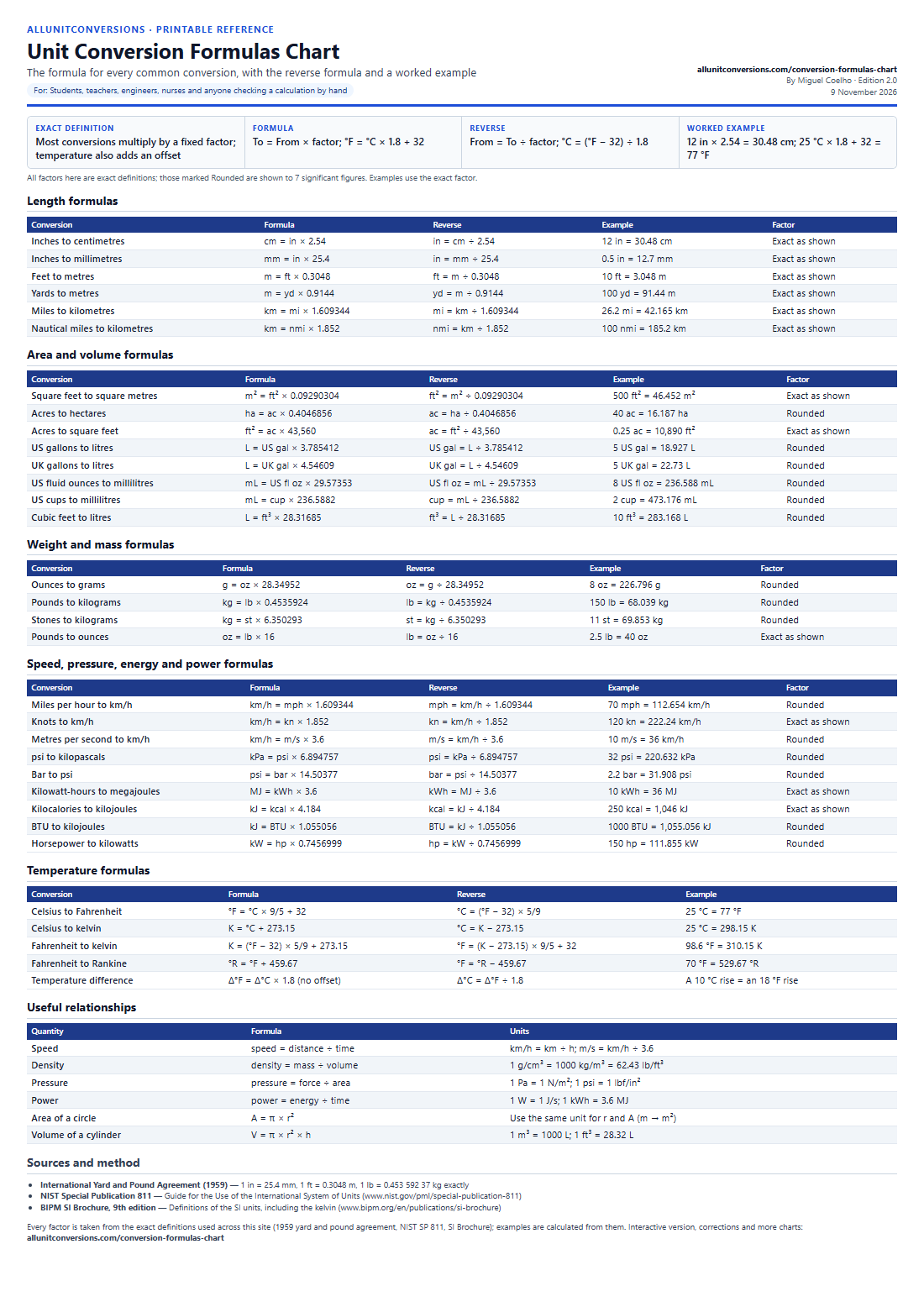
Printable unit conversion formulas cheat sheet
The formula for every common conversion, with the reverse formula and a worked example. Includes the exact definition, formulas, a worked example and sources. Conversion values are checked against the defining constants, and reference data is cited to its source, before the PDF is published.
Free to print, share and use in teaching materials with attribution (CC BY 4.0).
Also in the Classroom Unit Conversion Pack, with related sheets in one PDF.
Full unit conversion formulas cheat sheet
The formula for every common conversion, with the reverse formula and a worked example. These are the same tables as the printable PDF. For: Students, teachers, engineers, nurses and anyone checking a calculation by hand.
- Exact definition
- Most conversions multiply by a fixed factor; temperature also adds an offset
- Formula
- To = From × factor; °F = °C × 1.8 + 32
- Reverse
- From = To ÷ factor; °C = (°F − 32) ÷ 1.8
- Worked example
- 12 in × 2.54 = 30.48 cm; 25 °C × 1.8 + 32 = 77 °F
- Rounding
- All factors here are exact definitions; those marked Rounded are shown to 7 significant figures. Examples use the exact factor.
Length formulas
| Conversion | Formula | Reverse | Example | Factor |
|---|---|---|---|---|
| Inches to centimetres | cm = in × 2.54 | in = cm ÷ 2.54 | 12 in = 30.48 cm | Exact as shown |
| Inches to millimetres | mm = in × 25.4 | in = mm ÷ 25.4 | 0.5 in = 12.7 mm | Exact as shown |
| Feet to metres | m = ft × 0.3048 | ft = m ÷ 0.3048 | 10 ft = 3.048 m | Exact as shown |
| Yards to metres | m = yd × 0.9144 | yd = m ÷ 0.9144 | 100 yd = 91.44 m | Exact as shown |
| Miles to kilometres | km = mi × 1.609344 | mi = km ÷ 1.609344 | 26.2 mi = 42.165 km | Exact as shown |
| Nautical miles to kilometres | km = nmi × 1.852 | nmi = km ÷ 1.852 | 100 nmi = 185.2 km | Exact as shown |
Area and volume formulas
| Conversion | Formula | Reverse | Example | Factor |
|---|---|---|---|---|
| Square feet to square metres | m² = ft² × 0.09290304 | ft² = m² ÷ 0.09290304 | 500 ft² = 46.452 m² | Exact as shown |
| Acres to hectares | ha = ac × 0.4046856 | ac = ha ÷ 0.4046856 | 40 ac = 16.187 ha | Rounded |
| Acres to square feet | ft² = ac × 43,560 | ac = ft² ÷ 43,560 | 0.25 ac = 10,890 ft² | Exact as shown |
| US gallons to litres | L = US gal × 3.785412 | US gal = L ÷ 3.785412 | 5 US gal = 18.927 L | Rounded |
| UK gallons to litres | L = UK gal × 4.54609 | UK gal = L ÷ 4.54609 | 5 UK gal = 22.73 L | Rounded |
| US fluid ounces to millilitres | mL = US fl oz × 29.57353 | US fl oz = mL ÷ 29.57353 | 8 US fl oz = 236.588 mL | Rounded |
| US cups to millilitres | mL = cup × 236.5882 | cup = mL ÷ 236.5882 | 2 cup = 473.176 mL | Rounded |
| Cubic feet to litres | L = ft³ × 28.31685 | ft³ = L ÷ 28.31685 | 10 ft³ = 283.168 L | Rounded |
Weight and mass formulas
| Conversion | Formula | Reverse | Example | Factor |
|---|---|---|---|---|
| Ounces to grams | g = oz × 28.34952 | oz = g ÷ 28.34952 | 8 oz = 226.796 g | Rounded |
| Pounds to kilograms | kg = lb × 0.4535924 | lb = kg ÷ 0.4535924 | 150 lb = 68.039 kg | Rounded |
| Stones to kilograms | kg = st × 6.350293 | st = kg ÷ 6.350293 | 11 st = 69.853 kg | Rounded |
| Pounds to ounces | oz = lb × 16 | lb = oz ÷ 16 | 2.5 lb = 40 oz | Exact as shown |
Speed, pressure, energy and power formulas
| Conversion | Formula | Reverse | Example | Factor |
|---|---|---|---|---|
| Miles per hour to km/h | km/h = mph × 1.609344 | mph = km/h ÷ 1.609344 | 70 mph = 112.654 km/h | Rounded |
| Knots to km/h | km/h = kn × 1.852 | kn = km/h ÷ 1.852 | 120 kn = 222.24 km/h | Exact as shown |
| Metres per second to km/h | km/h = m/s × 3.6 | m/s = km/h ÷ 3.6 | 10 m/s = 36 km/h | Rounded |
| psi to kilopascals | kPa = psi × 6.894757 | psi = kPa ÷ 6.894757 | 32 psi = 220.632 kPa | Rounded |
| Bar to psi | psi = bar × 14.50377 | bar = psi ÷ 14.50377 | 2.2 bar = 31.908 psi | Rounded |
| Kilowatt-hours to megajoules | MJ = kWh × 3.6 | kWh = MJ ÷ 3.6 | 10 kWh = 36 MJ | Exact as shown |
| Kilocalories to kilojoules | kJ = kcal × 4.184 | kcal = kJ ÷ 4.184 | 250 kcal = 1,046 kJ | Exact as shown |
| BTU to kilojoules | kJ = BTU × 1.055056 | BTU = kJ ÷ 1.055056 | 1000 BTU = 1,055.056 kJ | Rounded |
| Horsepower to kilowatts | kW = hp × 0.7456999 | hp = kW ÷ 0.7456999 | 150 hp = 111.855 kW | Rounded |
Temperature formulas
| Conversion | Formula | Reverse | Example |
|---|---|---|---|
| Celsius to Fahrenheit | °F = °C × 9/5 + 32 | °C = (°F − 32) × 5/9 | 25 °C = 77 °F |
| Celsius to kelvin | K = °C + 273.15 | °C = K − 273.15 | 25 °C = 298.15 K |
| Fahrenheit to kelvin | K = (°F − 32) × 5/9 + 273.15 | °F = (K − 273.15) × 9/5 + 32 | 98.6 °F = 310.15 K |
| Fahrenheit to Rankine | °R = °F + 459.67 | °F = °R − 459.67 | 70 °F = 529.67 °R |
| Temperature difference | Δ°F = Δ°C × 1.8 (no offset) | Δ°C = Δ°F ÷ 1.8 | A 10 °C rise = an 18 °F rise |
Useful relationships
| Quantity | Formula | Units |
|---|---|---|
| Speed | speed = distance ÷ time | km/h = km ÷ h; m/s = km/h ÷ 3.6 |
| Density | density = mass ÷ volume | 1 g/cm³ = 1000 kg/m³ = 62.43 lb/ft³ |
| Pressure | pressure = force ÷ area | 1 Pa = 1 N/m²; 1 psi = 1 lbf/in² |
| Power | power = energy ÷ time | 1 W = 1 J/s; 1 kWh = 3.6 MJ |
| Area of a circle | A = π × r² | Use the same unit for r and A (m → m²) |
| Volume of a cylinder | V = π × r² × h | 1 m³ = 1000 L; 1 ft³ = 28.32 L |
Sources for this chart
Every factor is taken from the exact definitions used across this site (1959 yard and pound agreement, NIST SP 811, SI Brochure); examples are calculated from them.
- International Yard and Pound Agreement (1959) — 1 in = 25.4 mm, 1 ft = 0.3048 m, 1 lb = 0.453 592 37 kg exactly
- NIST Special Publication 811 — Guide for the Use of the International System of Units
- BIPM SI Brochure, 9th edition — Definitions of the SI units, including the kelvin
Related Converters & Charts
Unit Conversion Formulas Cheat Sheet FAQs
Common questions about the unit conversion formulas cheat sheet.
What is the formula to convert Celsius to Fahrenheit?
°F = °C × 9/5 + 32. For example, 25 °C × 1.8 + 32 = 77 °F. The reverse is °C = (°F − 32) × 5/9.
What is the formula to convert pounds to kilograms?
kg = lb × 0.45359237 (exact). 150 lb × 0.45359237 = 68.04 kg. The reverse is lb = kg ÷ 0.45359237.
What is the formula to convert miles to kilometres?
km = miles × 1.609344 (exact). A 26.2 mile marathon is 26.2 × 1.609344 = 42.165 km (the official distance is 42.195 km, 26.219 mi).
Can I download this chart as a PDF, CSV, or JSON?
Yes. Use the Download A4 PDF or US Letter PDF buttons for a printable version, or download the same tables as CSV or JSON from the links on this page.